

The secret to creating a customer funnel that boosts business revenue
Reading time: 10 minutes
Creating a customer funnel provides businesses with an overview of how customers interact with the company. This insight enables the development of appropriate strategies to optimize customer outreach and engagement, ultimately boosting sales and improving service quality. Furthermore, the customer funnel model helps businesses identify issues or weaknesses in customer interactions, allowing for improvements and the implementation of alternative measures to enhance service quality.
The Secret to Creating a Customer Funnel That Boosts Business Revenue
What is a customer funnel?
A customer funnel (also known as a “sales funnel” or “marketing funnel”) is a marketing concept describing the process a potential customer goes through before deciding to purchase a business’s product or service.
Creating a customer funnel involves various steps designed to provide a seamless customer experience—from the moment they first encounter the business’s product or service until they take the desired action.
The basic customer funnel model
Awareness
This is the stage where potential customers are first introduced to the business’s products or services. Businesses employ advertising strategies, online marketing, PR, or other activities to capture the attention of potential customers. Specifically, this might involve a blog post, a social media update, or a video containing content of value to the customer.
Through such content, potential customers become aware of the business and what it offers. If the content is compelling and sparks interest, they might decide to purchase the product or service immediately. However, if the content fails to persuade them, they will likely continue searching for and researching other products or services.
The awareness stage is about introducing your brand and sharing valuable content with customers. Crucially, the goal at this point is not immediate sales, but rather encouraging customers to return and remember your brand when they need relevant products or solutions in the future. At this stage, businesses need to create high-quality content that delivers value and maintain engagement with the audience to foster retention and generate future business opportunities.
Interest
Once reached, potential customers begin to take an interest in the business’s products or services and seek out information about them. During this phase, it is crucial to provide accurate and compelling information so that prospects can gain a clearer understanding of what is being offered.
Customers typically search for solutions on Google. They evaluate the issue at hand and gather information to verify that your product or service is the best choice. Therefore, to attract prospects, you need to optimize for SEO and provide as much useful information as possible.
However, pushing too hard for a sale at this stage can create pressure and backfire, causing prospects to turn away and look for other solutions. Instead, it is better to provide value and help prospects understand your product or service so they can make an informed purchasing decision.
Decision
At this stage, prospects are already interested in the product or service and are evaluating their options. They are deciding whether to purchase from your business or choose an alternative. This is a critical moment to present your best offer and persuade the prospect to make a purchase.
Businesses can use incentives—such as free shipping, discount codes, or gifts—to attract potential customers. Crucially, businesses must ensure their products or services meet the needs and expectations of potential customers; doing so builds trust and persuades them to make a purchase.
Action – Customer Action
This is the final stage of the customer funnel. Potential customers become actual customers by purchasing the business’s products or services. Additionally, businesses need to provide excellent customer service to retain customers and generate future business opportunities.
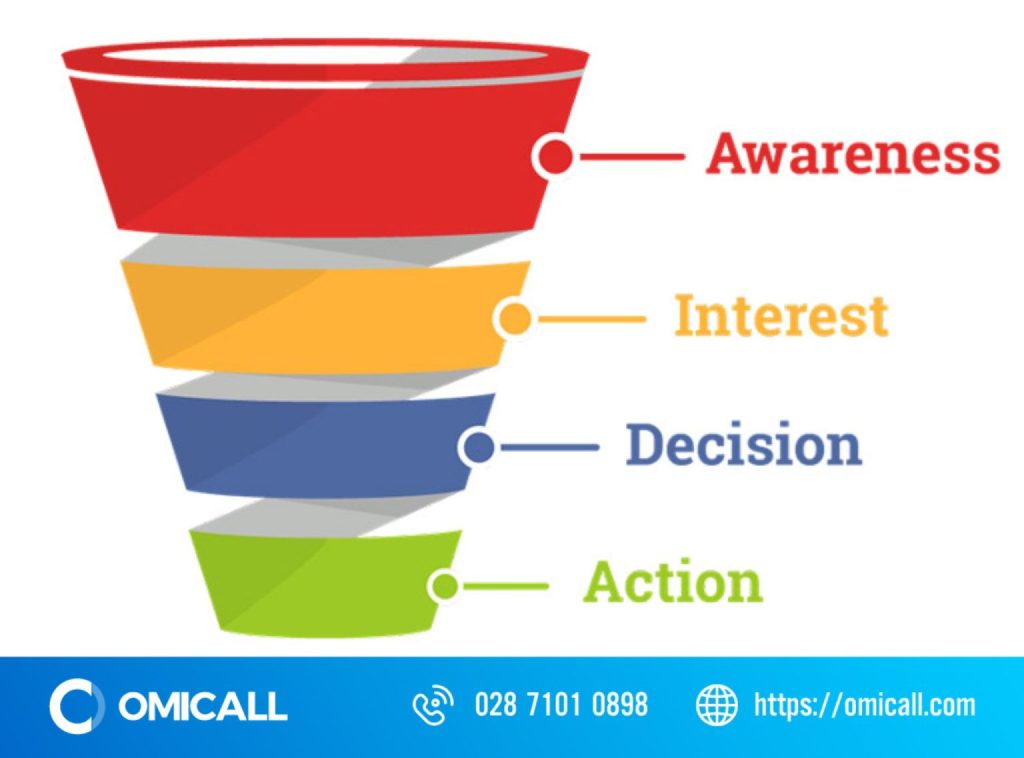
The Basic Customer Funnel Model
Why create a customer funnel?
Identify target prospects
A customer funnel helps businesses define their potential customer base, enabling them to focus on developing marketing and advertising strategies tailored to the prospects they are targeting.
Optimize marketing strategies
By analyzing the customer funnel, businesses gain a better understanding of the obstacles and challenges prospects face during the purchasing decision process. Consequently, businesses can optimize their marketing strategies to address these issues and boost sales performance.
Increase conversion rates
The customer funnel provides insight into the prospect’s journey prior to purchasing a product or service. This allows businesses to optimize websites, marketing content, and other strategies to increase the conversion rate from prospects into actual customers.
Measure and evaluate marketing strategy effectiveness
The customer funnel enables businesses to measure and evaluate the effectiveness of their marketing and advertising strategies.
Businesses can track the number of prospects, conversion rates, and sales figures to assess strategy performance and make adjustments as necessary.
Drive sales growth
Using a customer funnel allows businesses to identify accurate customer insights. This enables effective nurturing of prospects until they are ready to make a purchase decision, thereby driving sales growth for the business. Customer Retention
A sales funnel also helps maintain and grow your base of both potential and existing customers by establishing a plan for post-purchase marketing activities. This keeps customers engaged and creates opportunities for them to return and purchase your products or services in the future.
6 Steps to Create a Customer Funnel
Step 1: Build a Customer Persona
You need to clearly define the audience you wish to target. This is a crucial step for developing strategies and plans tailored to your target customers. To create an effective customer funnel, you must analyze the behavior of your target audience. This process allows you to study customer behavioral traits, thereby identifying the audience best suited for your products or services. It is essential to focus on target customers who have a genuine need for your offerings and to deliver messages that resonate with them.
Step 2: Attract Customers
To effectively attract customers, you need to create compelling and impressive content. Businesses can employ the following methods:
- Develop content based on the inbound marketing model and publish it across all social media platforms.
- Diversify content formats by utilizing images, infographics, videos, and more.
- Identify suitable channels for marketing and advertising campaigns. Additionally, the business needs to determine the required budget and pinpoint the channels most likely to deliver high-impact advertising results.
This is a crucial step for spreading the word about and promoting your brand, helping customers become more familiar with you.
Step 3: Build a Landing Page
A landing page is the destination page where customers arrive after clicking on your advertisement or content. This page must provide comprehensive information about your product or service while persuading potential customers to take the action your business desires. You need to provide clear instructions on what customers should do—such as filling out a registration form, making a purchase, downloading a document, or watching a video—to bridge the gap to the next step.
Step 4: Implement Email Marketing Campaigns
Email marketing is a highly effective tool for reaching and engaging with potential customers. By delivering useful and valuable information via email, you can boost engagement and generate customer interest in your products or services. To increase conversion rates, you should apply this strategy to both existing customers and those who have not yet used your products.
- For customers who have already purchased and used the product or service, businesses should focus on providing support, addressing inquiries, and sending additional offers to boost repeat business.
- For potential customers who have not yet used the product or service, you need to identify the reasons for their hesitation and provide solutions—such as discount codes or product consultations—to build their confidence in the offering.
However, when emailing or calling customers, avoid overdoing it or contacting them incessantly, as this can be annoying and frustrating, potentially leading to lost business. Pay close attention to frequency and content; ensure that the information you send is genuinely useful and relevant to the customer.
Step 5: Stay in touch
To build an effective customer funnel, you must maintain relationships with your existing customers. This fosters trust and boosts interest in your products or services. You can stay connected through email, text messages, or social media channels.
Provide your customers with useful, valuable information, and offer promotions or events to encourage engagement and strengthen your relationship with them. Since existing customers can become valuable prospects for future business, make an effort to stay in touch and ensure their satisfaction.
Step 6: Monitor changes and implement appropriate strategies
To ensure your customer funnel operates sustainably and effectively, it is crucial to monitor changes, analyze customer preferences, and track market fluctuations. Based on these insights, you should promptly devise new strategies to improve your customer funnel.
Creating a customer funnel is no simple task, but it can significantly boost business performance. The ultimate goal of a marketing funnel is to increase purchase volume and value while driving brand awareness and referrals to expand your marketing reach.

VIHAT TECHNOLOGY Co., Ltd
Headquarters: ViHAT Building – 06 Street No. 16 (Him Lam Residential Area) – Hiep Binh Chanh Ward – Thu Duc District – Ho Chi Minh City
Hanoi Branch: Floor 15, LADECO Building, 266 Doi Can, Ba Dinh, Hanoi
Cambodia Branch: Thida Rath #154 St. 33MC, Sangkat Steung Meanchey, Khan Mean Chey, Phnom Penh

-
 What is TikTok advertising? Advertising policies and how it works.
-
 Exploring Conceptual Selling – Understanding Modern Sales Trends Correctly
-
 What is a KOC? Distinguishing between KOLs and KOCs.
-
 What Are Customer Insights? Revealing How to Effectively Uncover Them
-
 What is Digital Marketing? 10 Effective Forms of Digital Marketing
-
 What is Online Marketing? Types of Online Marketing





