

The AIDA Model – A Formula for Successful Marketing Campaigns
Reading time: 8 minutes
In the process of developing marketing strategies, the AIDA model is one of the classic “formulas” frequently applied by businesses. However, many people are still quite vague about this concept. Therefore, this article will provide the most complete and detailed knowledge so that we can better understand the model behind the success of many famous brands.

Vietnam’s leading AI-powered multi-channel virtual call center.
What are the basic concepts of the AIDA model?
What is the AIDA model ? – This is an acronym representing the four stages of customer perception: A (Attention) – I (Interest) – D (Desire) – A (Action). These correspond to: Attracting attention – Creating interest – Creating desire – Taking action . AIDA is a classic formula applied by businesses in their communication and marketing activities.
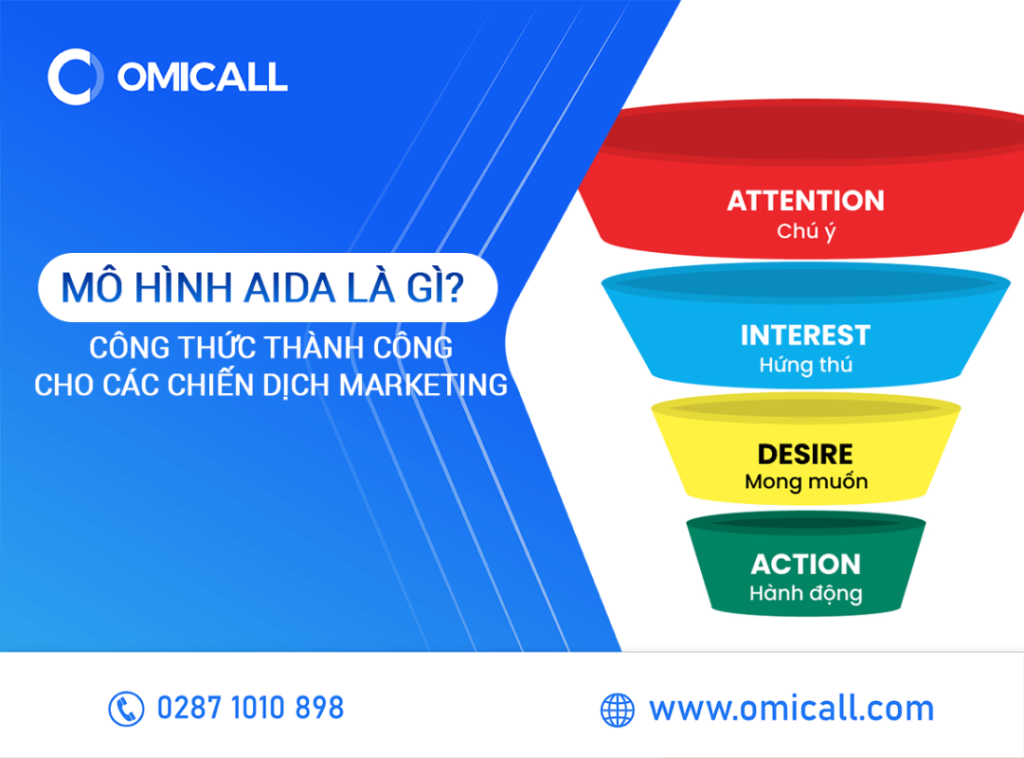
What is the AIDA model?
Specifically, the AIDA model in marketing refers to the cognitive process throughout the entire customer journey. This allows marketers to easily analyze and select the most effective strategies for each specific stage, helping businesses achieve their desired revenue with the most optimal marketing costs.
Details of the stages in the AIDA model
As mentioned in the introduction above, the AIDA model in Marketing consists of four steps: A (Attention) – I (Interest) – D (Desire) – A (Action), respectively: Attracting attention – Creating interest – Creating desire – Taking action. Let’s analyze each specific implementation step of this value model in detail:
A – Attention: Attracting attention
First, you must truly understand the problems your customers are facing before they decide to buy your product. Then, create content that makes a strong first impression. Especially in this age of explosive media and customers seeing countless advertisements every day, the “A” in AIDA becomes even more important.

Attention – Attracting attention
To spark initial curiosity and attention, marketers need to know how to apply the right tools, methods, and mindset to tap into the curiosity of their target customers. This will help you achieve initial success in your journey to win over customers.

I – Interest: Creating enjoyment
The next step in this model is I – Interest. This is a crucial step that greatly determines whether customers are truly interested in your product or service. Once you’ve generated attention and curiosity, start looking for new methods and content to create further interest in your product/service.
This is the stage where you consolidate and establish a better “relationship” between customers and your marketing message. To implement it effectively, you need to truly understand your customers’ needs and choose a message that resonates with their interests and values.
D – Desire: The desire to possess
This is a rather delicate stage for Interest because customers will quickly move on if you successfully execute the Interest move. Once you’ve tapped into the customer’s deep-seated “pain points,” it’s easy to understand why they’ll start desiring the product/service.
At this stage, focus on highlighting the superior value and benefits of the product/service you are selling. Show customers that their problems and pain points will be solved through the compelling content and messages you deliver.
A – Action: The act of purchasing
The final step in the AIDA model is to encourage customers to make a purchase decision and generate sales for the organization. To speed up this process, you can use call-to-action methods to heighten customer emotions.

A – Action: The act of purchasing
How can the AIDA model be applied to marketing activities?
In communications and marketing, AIDA serves as a guiding principle for each specific campaign within a business. However, it requires flexible application and continuous adjustment to achieve optimal results: Campaign effectiveness should be measured through specific metrics.
Notebook
The main purpose of this first phase is to attract customer attention and curiosity, and increase brand visibility in the market. Therefore, key channels that can be used in this phase include SEO, social media, online PR, content marketing, etc. Furthermore, effectiveness will be measured based on metrics such as impressions, reach, engagement, and clicks.
Interest
Next, building a connection between customers and the brand will be the most important goal at this stage. Some typical metrics for evaluating effectiveness at this step include: user time spent on the website; bounce rate; website traffic; post and ad engagement; website traffic from email; etc.

The AIDA model serves as a “guide” for marketing campaigns.
Desire
At this stage, you need to focus on conveying the outstanding value that your brand, product/service offers to customers. This will tap into their desire to own the product or service, helping them solve their underlying pain points. Businesses can measure effectiveness with metrics such as: engagement on social media platforms; or website traffic from other channels;…
Action
This is the crucial stage for the campaign’s success. Increasing conversion rates from marketing channels will be a secondary objective. Metrics used in this step include: the number of orders for B2C businesses; the number of completed orders from online marketing channels for B2B businesses;…
Advantages of the AIDA model when applied to marketing activities.
The AIDA model serves as a solid foundation for the specific implementation steps of any marketing and communication strategy. Effective application of AIDA will help businesses better understand customer psychology and choose the right channels for each stage of the process.

Advantages of the AIDA model
However, the crucial factor determining the success of this model is understanding the customer. The more detailed and accurate your customer profile is, the higher the success rate of the AIDA model will be. Precisely identifying your target customer makes it easier to choose the most appropriate approach and deliver the right message at each specific stage.
Some common errors encountered when applying the AIDA model.
Focusing only on one stage of the model
The AIDA model comprises four steps in the customer perception process, so each step plays a crucial role. A common mistake some businesses make is focusing on only one of the four steps and investing less in the others. This can lead to a failed marketing or communication campaign without the support of the other stages.
Each part of the AIDA model has not yet reached the required standard.
Even if you’ve followed all the steps in this “classic” model, failing to reach the necessary standard at any stage will affect the overall campaign’s success. Therefore, continuous monitoring, evaluation, and optimization at each stage will help you more easily control the project’s effectiveness.
Inconsistent messaging
Throughout all stages, building a core message is crucial for making a lasting impression on customers. Therefore, unifying a key message is vital for a plan based on the AIDA model.
Conclude
In summary, the above overview provides a wealth of knowledge about the AIDA model – the formula for success of many major brands. This will help you consolidate essential knowledge and easily apply it accurately to your own products/services.
VIHAT TECHNOLOGY Co., Ltd
Headquarters: ViHAT Building – 06 Street No. 16 (Him Lam Residential Area) – Hiep Binh Chanh Ward – Thu Duc District – Ho Chi Minh City
Hanoi Branch: Floor 15, LADECO Building, 266 Doi Can, Ba Dinh, Hanoi
Cambodia Branch: Thida Rath #154 St. 33MC, Sangkat Steung Meanchey, Khan Mean Chey, Phnom Penh

-
 What is TikTok advertising? Advertising policies and how it works.
-
 Exploring Conceptual Selling – Understanding Modern Sales Trends Correctly
-
 What is a KOC? Distinguishing between KOLs and KOCs.
-
 What Are Customer Insights? Revealing How to Effectively Uncover Them
-
 What is Digital Marketing? 10 Effective Forms of Digital Marketing
-
 What is Online Marketing? Types of Online Marketing





