

What is the Business Model Canvas? How to apply it effectively in 2023
Reading time: 9 minutes
The term “Business Canvas” is no longer unfamiliar to those involved in the startup phase of their businesses. It’s a model that has gained popularity and is widely adopted by many large companies worldwide.
So what is the Canvas model ? How can we apply the Canvas model effectively? Let’s find out with OMI in the article below!

Vietnam’s leading AI-powered multi-channel virtual call center.
What is a Canvas model?
The English name for the Business Model Canvas is Business Model Canvas (BMC). This is a well-known and effective solution developed by Swiss entrepreneur Alexander Osterwalder.
The Business Model Canvas is a simple and effective tool for describing a business model or a new product. It’s a graphical representation divided into different sections, allowing users to focus on the key elements of a business or product model.
The goal of the Business Plan Canvas is to guide and implement business plans that help businesses achieve stability and increase profitability.

What is a Canvas model?
Why should you apply the Model Canvas in business?
Successful startups never immediately launch their first idea to the market. Instead, their product/service usually goes through many rounds of testing and refinement before reaching its final, perfected version.
The Business Model Canvas helps businesses focus on the key elements of a new business model or product/service, making strategy development and management easier.
Similarly, businesses will face fewer risks and be more sustainable if they consider several business models before deciding to adopt a particular one.
For those who want to start a business, especially those with a passion for entrepreneurship, the Business Model Canvas offers an effective way to apply and simplify all business strategies and plans.
Canvas models and their amazing benefits.
By simplifying cumbersome business plans in the most intuitive way, the Canvas model has gained widespread popularity in the business world due to its benefits and effectiveness, specifically:
Understand the business model
The Business Model Canvas helps businesses better understand the various elements of their business model. This makes it easier to develop strategies and optimize business operations.
Optimizing costs and resources
With the Business Model Canvas, businesses can identify the resources needed to implement their business model and find ways to optimize costs effectively.
Developing an effective marketing strategy
Beyond simply providing information about customers and marketing channels, the Canvas model helps business owners identify various approaches to reaching their target customers.
Helping to understand the opponent
By sketching out a competitor’s business model canvas, businesses will gain a better understanding of their competitors’ strengths and weaknesses, what they can and cannot do. From there, managers can develop specific strategies and design a more suitable business model for their own company.

Canvas Models and 4 Great Benefits
9 pillars in the Canvas model
The 9 value elements in the Canvas model represent the four main sides of a business (customers, value, financial capabilities, and physical assets). Let’s explore the details below to understand what the 9 main categories in the canvas model are .
Customer segments
Customer segmentation describes the target audience or consumers facing a particular problem that a business can solve. This is considered one of the most important parts of the business model canvas, because this primary user group will determine the entire strategy and approach of the business.
To easily identify the target market, business owners can divide it into the following five sub-markets for analysis:
- Mass market
- Mixed market (multi-sided market)
- Niche market
- Diverse market segments
- Diverse customer base in the market.
Value proposition
After identifying the target customer profile based on the characteristics of the product/service, businesses can proceed to propose value propositions. Simply put, these are the reasons why customers choose the company’s product over a competitor’s. This will be demonstrated through two key characteristics:
- What value do the company’s products and customer services bring to users?
- Why should customers buy your product/service?
Key activities
Key activities include the tasks that a business needs to implement to ensure business success, including activities such as:
- Product research and development;
- Production activities;
- Managing the distribution system;
- Marketing attracts customers;
- Operating the store;
- After-sales customer service,…
For example, with a business idea to open a bubble tea shop, the main activities would include: purchasing raw materials and brewing equipment, promoting the product, selling bubble tea, etc.
Key resources
Key resources are the assets necessary for a business to operate, such as: finance, physical infrastructure, intellectual resources, and human resources. Listing these resources is crucial, as it helps you clearly visualize the product/service you will offer to your customers.
Different resources will influence your business plan differently. Therefore, by thinking about the resources you need to establish, your business will easily be able to determine which resources are necessary.

9 pillars in the Canvas model
Key suppliers and partners
For a business to operate effectively, business owners need to build relationships with partners. Here are four ways to build partnerships:
- Strategic alliance;
- Cooperation for mutual development;
- Joint venture;
- The relationship between supplier and partner.
For example, you could collaborate with a partner to organize an online or offline event on a prominent social topic, offering discounts/vouchers to your target customer group when they attend.
Distribution channels
For distribution channels, you need to describe the communication and distribution channels you plan to use to reach customers. Based on the three channels below, you can deliver the target value proposition that customers desire.
- Direct distribution channels : In-store sales, direct sales teams, product consultants, etc.
- Indirect distribution channels: Partner stores, sales agents, retailers, etc.
- Online distribution channels: Online stores: Website, Fanpage, Facebook, Instagram, TikTok, etc.
For startups, identifying customer channels is the first step before establishing distribution channels. Then, you need to conduct a SWOT analysis to assess the strengths of your distribution channels and build new customer channels.
Customer relationships
In the Customer Relationships Canvas model , customer relationships are the types of relationships a business wants to build with its customers. In other words, this element answers the question: How to attract new customers or retain existing ones?
First, you need to identify the type of customer relationship you want to build. Then, assess the value of each customer based on their purchase frequency. Investing in relationships with loyal customers will help your business generate a stable revenue stream.
Revenue streams
Revenue sources will detail how the business earns revenue from service fees, fixed rates, subscriptions, etc.
This section may also include information about what customers are willing to pay for the product/service and any products/services offered for free.
Cost structure
This is the amount of money a business owner needs to spend to run their company; the cost structure will determine the price of the product/service. Essential costs for running a business include:
- Input material costs;
- Costs of working with partners;
- Invest in equipment and machinery;
- Rent for the premises;
- Employee salaries;
- Marketing and sales costs;
- …
All of these cost structures will affect the pricing of a company’s products/services.
Thus, this is also the overall picture of all business issues systematized within the 9 value elements of the Business Model Canvas . Once you understand what customers want, you can design a business model with a strong message, focused resources, and specific actions. From there, you can deliver unique value to customers that your competitors don’t offer.
Case Study: Businesses that successfully applied the Canvas model
Because of its simplicity, ease of understanding, and usefulness, the Canvas model is favored by many businesses. Today, many businesses around the world, and specifically in Vietnam, have successfully applied the Canvas model and achieved positive results, such as: Apple, Uber, BMW, Vinamilk, Nestlé, Tiki, Grab, etc.
Below are specific examples of two large businesses that have successfully applied the Canvas model.
Vinamilk
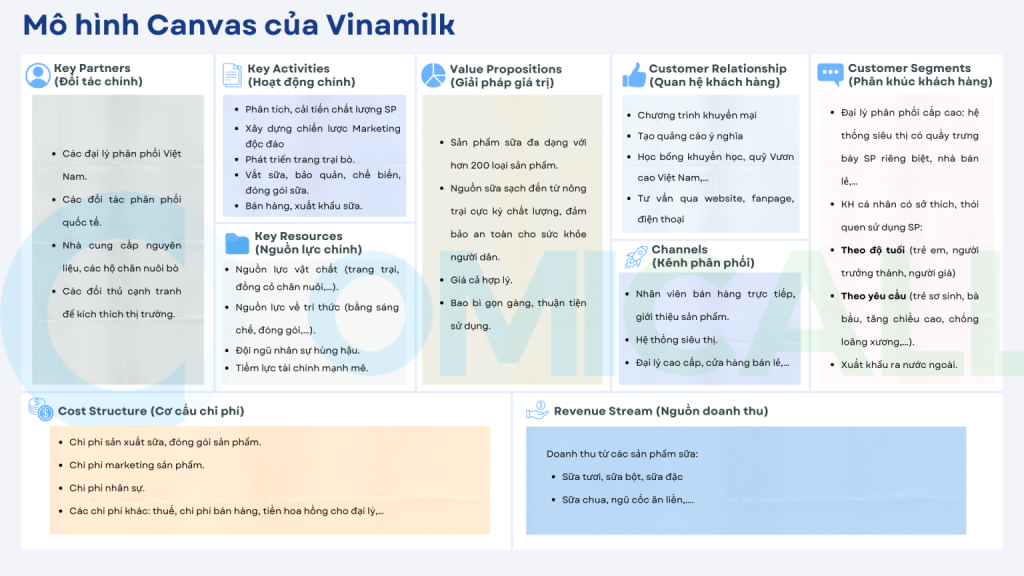
Vinamilk’s Canvas Model
Grab
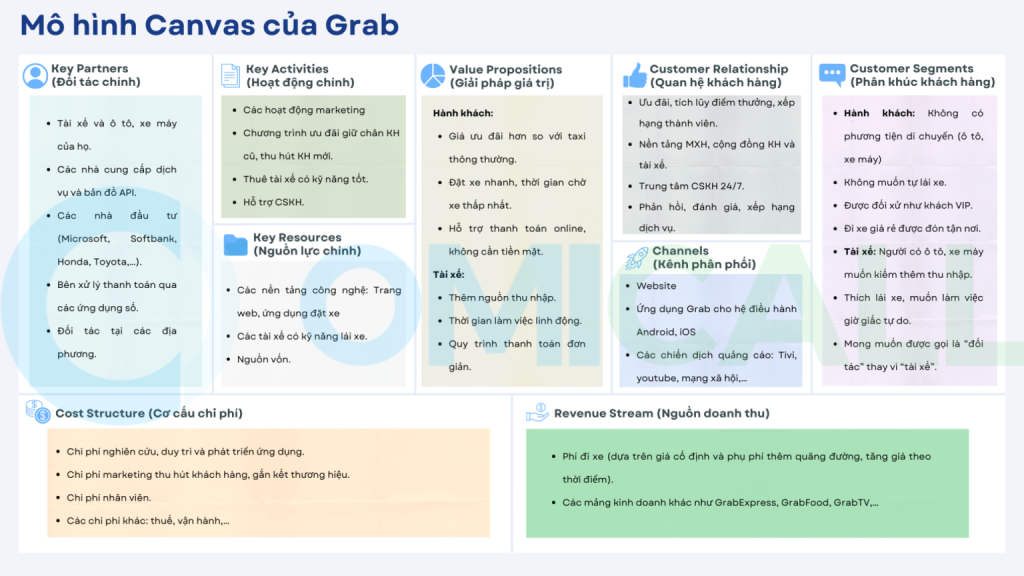
Grab’s Canvas Model
In conclusion
As you can see, the Business Model Canvas is an unlimited model. It’s a great tool for those passionate about business. However, not using the Canvas isn’t a problem, but if you do use it, it will be an important foundation to help you organize information and continue developing your ideas.
Hopefully, the information about what the Canvas model is in this article will be helpful to you.
VIHAT TECHNOLOGY Co., Ltd
Headquarters: ViHAT Building – 06 Street No. 16 (Him Lam Residential Area) – Hiep Binh Chanh Ward – Thu Duc District – Ho Chi Minh City
Hanoi Branch: Floor 15, LADECO Building, 266 Doi Can, Ba Dinh, Hanoi
Cambodia Branch: Thida Rath #154 St. 33MC, Sangkat Steung Meanchey, Khan Mean Chey, Phnom Penh

-
 What is TikTok advertising? Advertising policies and how it works.
-
 Exploring Conceptual Selling – Understanding Modern Sales Trends Correctly
-
 What is a KOC? Distinguishing between KOLs and KOCs.
-
 What Are Customer Insights? Revealing How to Effectively Uncover Them
-
 What is Digital Marketing? 10 Effective Forms of Digital Marketing
-
 What is Online Marketing? Types of Online Marketing





