

AI-Powered Call Scoring to Evaluate Employee Performance
Reading time: 6 minutes
AI-powered call scoring is becoming a vital tool for businesses to enhance customer service quality while providing deep, detailed insights into employee performance.
Introduction to AI-powered call analysis and scoring
With the rapid advancement of cloud computing and the Industry 4.0 era, vast amounts of user data are now migrated to and stored in the cloud. However, much of this data remains underutilized or is too complex to analyze effectively, often resulting in missed opportunities. Call data is a prime example of this.
Since call data typically exists in audio format, traditional methods require a large team of supervisors to manually review calls and extract the information needed for management decisions—such as identifying poor-quality calls or capturing customer feedback on services.
To address this challenge—and drawing on over nine years of experience in providing VoIP and customer interaction management solutions—we developed the OMI Analysis toolkit to derive actionable insights from calls.

Vietnam’s leading AI-powered multi-channel virtual call center solution
The importance of AI-driven call analysis
Imagine an alphabet of 24 letters that, when combined, can create hundreds of meaningful poems and thousands of sentences. Similarly, we can establish a foundation of granular parameters that aggregate into broader criteria for evaluating specific aspects of a call. This approach not only clarifies the data but also allows for a high degree of customization.
To analyze hundreds of thousands of calls daily, we developed an ASR (Speech-to-Text) tool capable of converting audio into text. From there, we define “Parameters”—data points extracted from the call, such as background noise levels, keywords, speaker gender, and so on. We then create sets of criteria based on these parameters, utilizing complex mathematical formulas to calculate the weighted score for each criterion. Users have the flexibility to configure everything to generate parameters that best suit their specific analysis needs.
Data requiring configuration
Click the “Settings” icon on the main menu bar, then navigate to the AI / Call Analysis menu.
Analysis parameters
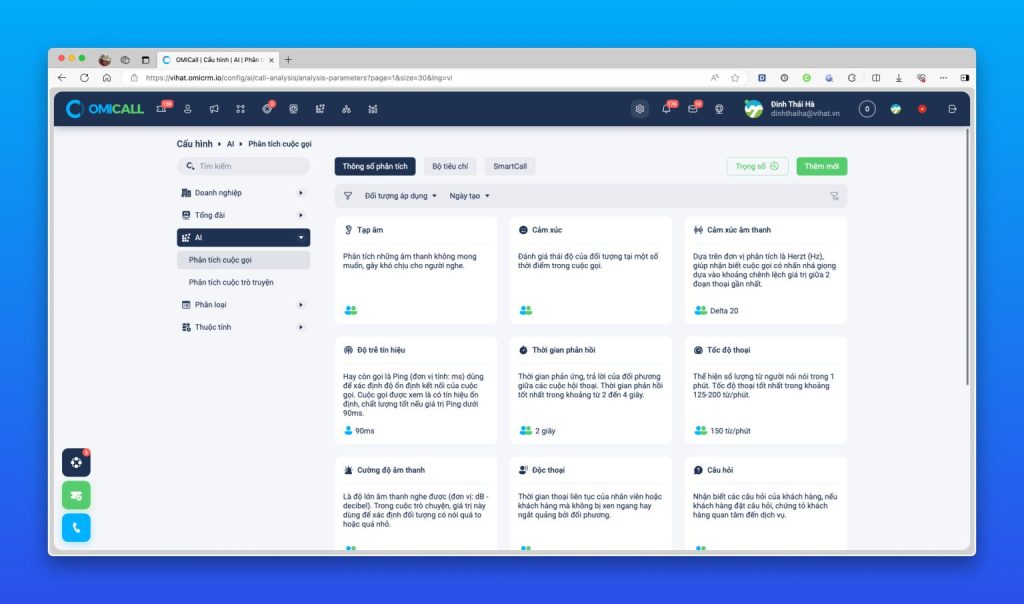
Call Analysis Parameters
Analysis parameters define the specific fields to be processed by the AI. Business owners can select the parameters that best suit their specific business needs.
Each parameter can be applied to analyze specific entities, such as the customer or the employee handling the call. Additionally, for certain parameters, business owners can define standard values used to calculate quality scores within the analyzed call details.
Criteria Sets
An AI-based call scoring criteria set comprises multiple individual criteria, with each set assigned to a specific call purpose. This setting determines which calls will be evaluated against that specific criteria set.
Furthermore, you can configure the system to apply a criteria set only to a specific employee or group of employees. If no specific configuration is made, the default setting ensures that calls from all employees in the organization are analyzed using this criteria set.
Each criterion within a set is defined by specific analysis parameters. Users can assign custom names to each criterion as desired.
For example, a “Good Response Time” criterion might consist of two parameters:
Response time for both the employee and the customer is under 2 seconds, occurring in at least 49% of instances.
Background noise occurs fewer than 2 times.
Users can view sample data and quickly incorporate it into their criteria sets by clicking the “View Sample Data” button.

Call Analysis Criteria
The scoring mechanism for the criteria is applied as follows:
The score for each individual criterion is calculated based on the weights of specific analysis parameters. The overall score is determined by the weight assigned to each criterion.
Analyzed Calls
Call List
Calls with associated recordings are analyzed by AI and displayed in the “Calls” menu. Users can customize the displayed analysis attributes by clicking the “Display Configuration” button. Additionally, users can filter calls based on specific criteria scores, facilitating the efficient search and management of important calls.
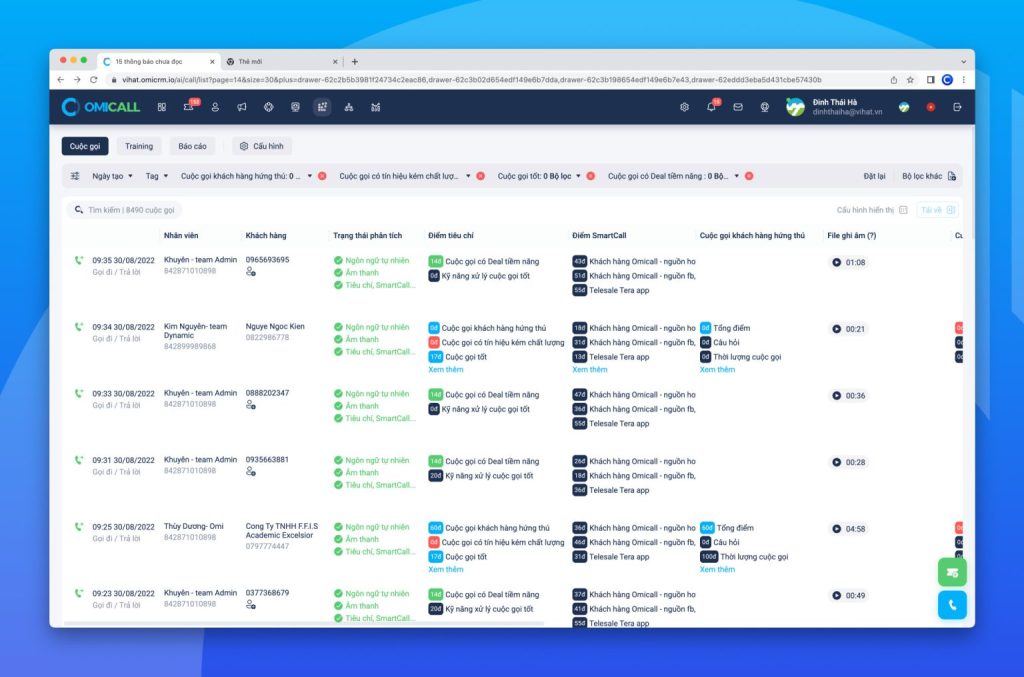
Analyzed Call List
Analyzed Call Details
In the call details section, users can view a summary of the transcribed call in the upper area. This makes it easy to track and understand the call content without needing to listen to the entire recording, thereby saving time and enhancing work efficiency.
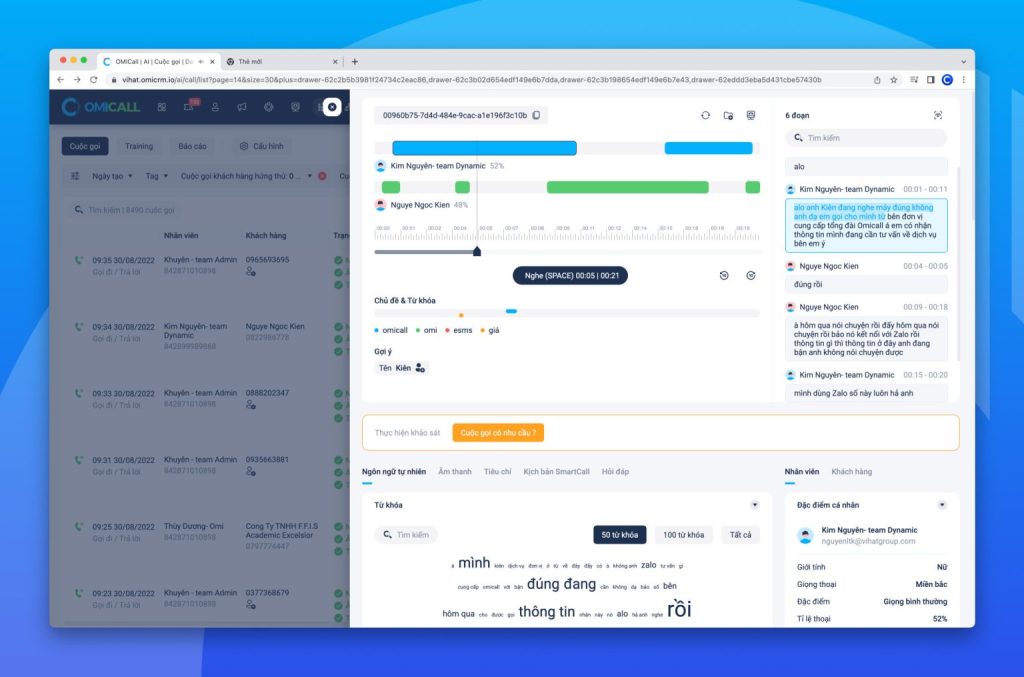
Call Detail Analysis
Natural Language
Analyzes elements such as keywords, sentiment, service ratings, service refusals, appointments, and questions.
Audio
Analyzes audio-related aspects including emotion, intensity, latency, background noise, response time, monologue, and speaking rate.
Criteria
Evaluates all criteria sets based on the call’s purpose, ensuring that the specific requirements for each call are considered and assessed.
Quality Assessment
Provides key analytical data such as gender, regional accent, voice characteristics, talk-to-listen ratio, and a quality score. This score is based on the business’s standard configuration parameters, helping to determine the call’s effectiveness and quality.
Conclusion
In summary, AI-based call scoring not only ensures accuracy and efficiency in quality assessment but also helps businesses improve customer service and boost productivity. Implementing AI technology in the call scoring process fosters sustainable growth and enhances competitiveness in the market.
For more information, please contact:
VIHAT TECHNOLOGY Co., Ltd
Headquarters: ViHAT Building – 06 Street No. 16 (Him Lam Residential Area) – Hiep Binh Chanh Ward – Thu Duc District – Ho Chi Minh City
Hanoi Branch: Floor 15, LADECO Building, 266 Doi Can, Ba Dinh, Hanoi
Cambodia Branch: Thida Rath #154 St. 33MC, Sangkat Steung Meanchey, Khan Mean Chey, Phnom Penh

-
 What is TikTok advertising? Advertising policies and how it works.
-
 Exploring Conceptual Selling – Understanding Modern Sales Trends Correctly
-
 What is a KOC? Distinguishing between KOLs and KOCs.
-
 What Are Customer Insights? Revealing How to Effectively Uncover Them
-
 What is Digital Marketing? 10 Effective Forms of Digital Marketing
-
 What is Online Marketing? Types of Online Marketing





