

Comparing OMICall and 3CX: A Phone System That Does More Than Just Make Calls
Reading time: 19 minutes
In today’s competitive business environment, every call is a crucial opportunity. Call centers are no longer just tools for making calls; they have gradually become the heart of every customer service strategy. Among the many options on the market, OMICall and 3CX stand out as two names with distinct strengths. So which solution is truly right for your business? Let’s compare OMICall and 3CX call centers through the most important aspects to find the optimal choice.
1. Overview of OMICall and 3CX call centers
OMICall – Vietnam’s leading AI-powered multi-channel call center.
OMICall is a pioneering virtual call center platform in Vietnam, designed to comprehensively address communication, customer care, and customer service system operations challenges for Vietnamese businesses of all sizes.
More than just a traditional call system, OMICall integrates modern technologies such as VoIP, cloud computing, artificial intelligence, and omni-channel communication. This helps businesses handle calls, store customer data, and interact seamlessly across multiple platforms such as phones, Facebook, Zalo, and SMS.
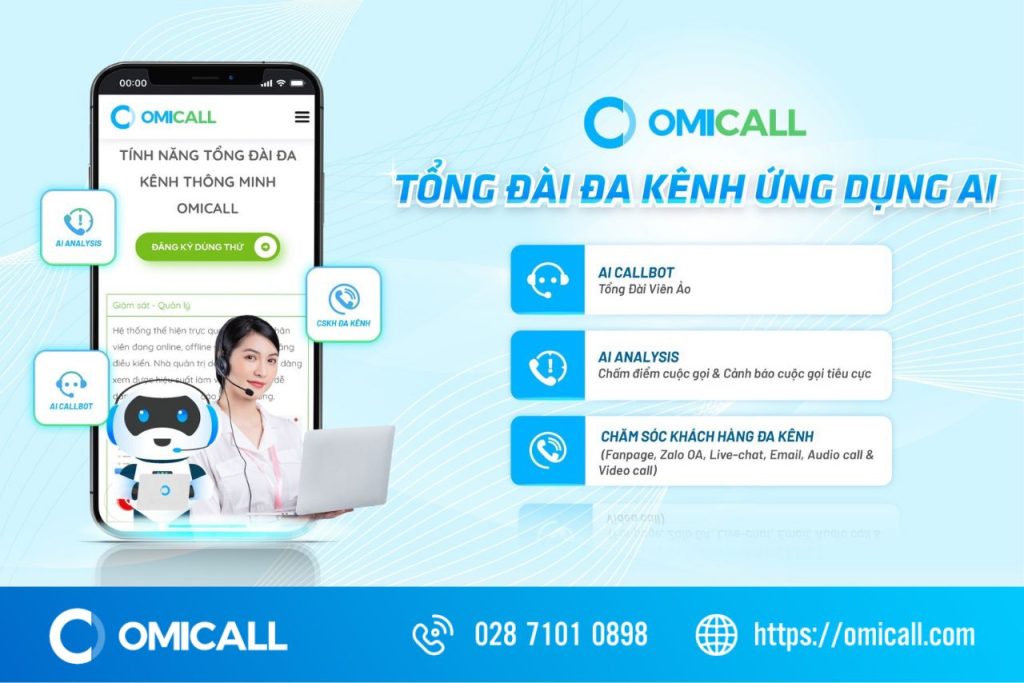
OMICall – Vietnam’s leading AI-powered multi-channel call center.
Key features of OMICall:
- Ultra-fast deployment, infrastructure-independent: Developed as a SaaS (Software-as-a-Service), OMICall does not require on-premise hardware installation, significantly saving businesses time and deployment costs.
- A comprehensive communication ecosystem: OMICall not only provides calling functionality but also supports integrated CRM, customer history management, automatic call scripting, and multi-channel synchronization from a single interface…
- Intelligent reporting and employee performance evaluation: From real-time dashboards to call data analytics systems, OMICall helps team leaders effectively manage telesales, customer service, hotline staff, and more.
- Optimized for the Vietnamese market: OMICall understands Vietnamese customer behavior and customizes its system to suit local businesses – from integrating Zalo OA and intra-network messaging to handling dedicated phone numbers.
3CX PBX – An IP PBX solution with superior customization capabilities.
3CX is a prominent multi-platform IP PBX system used by hundreds of thousands of businesses worldwide. Unlike traditional PBX systems that require complex hardware, 3CX operates as specialized software that can be flexibly deployed on-premises, in a private cloud, or on public cloud platforms such as Amazon Web Services, Google Cloud, and Azure.
3CX’s outstanding strength lies in its flexibility and integration capabilities – from organizing HD video conferencing and supporting call center agents remotely via mobile applications, to deep integration with leading global CRM platforms.
Key advantages of the 3CX call center:
- Flexible deployment – on-premise or cloud: Suitable for both businesses that prefer internal data control and those that prefer cloud-based applications.
- Integrated video conferencing support: 3CX is more than just a voice system; it’s a Unified Communication solution for businesses – encompassing voice, video, live chat, and internal messaging.
- Highly customizable: Being closed-source yet highly extensible, 3CX allows for the integration of APIs, scripting, and plugin modules to suit specific requirements.
- Affordable cost – especially for medium and large businesses: With a free plan for up to 10 users, and flexible pricing based on the number of simultaneous calls, 3CX is an attractive option for expanding businesses.
2. Detailed comparison of OMICall and 3CX call center.
2.1 Regarding the deployment platform
OMICall
OMICall’s call center is developed as a purely cloud-based platform, operating entirely on cloud computing technology. This deployment model does not require investment in on-premise hardware infrastructure, saving initial costs and system setup time. When choosing OMICall, businesses only need an internet connection to start using the service immediately. Installation, maintenance, and system updates are all performed remotely by OMICall’s technical team, eliminating the burden of technical operations for businesses. OMICall’s SaaS (Software-as-a-Service) deployment model is particularly suitable for small and medium-sized enterprises (SMEs) that do not have a dedicated internal IT team, or businesses that need fast deployment and budget optimization. Thanks to this feature, OMICall provides a streamlined, accessible deployment experience while still ensuring all the modern features of a professional call center system.
3CX

3CX Call Center
In contrast, 3CX is a software-based IP PBX solution that stands out for its high deployment flexibility. Businesses can choose to install 3CX in several ways: on-premise deployment on a private server, installation on a private cloud platform such as Amazon Web Services, Microsoft Azure, or using 3CX’s official hosting service. This diversity in deployment models allows 3CX to meet the needs of many types of businesses, especially medium and large enterprises that already have IT infrastructure or require tight data control. On-premise deployment gives businesses full control over their internal data, while cloud hosting can save long-term operating costs if properly optimized. However, this flexibility comes with higher technical requirements and deployment time, necessitating businesses to have knowledgeable personnel or technical partners to operate and maintain the system effectively.
Therefore, if a business needs a simple, fast, cost-effective call center solution and doesn’t want to get involved with existing technology infrastructure, OMICall is a suitable choice. Meanwhile, if the business has an in-house technical team, requires a highly customizable system, or has specific security and integration requirements, 3CX offers many advantages in terms of deployment architecture and control capabilities.
2.2 Regarding deployment and operating costs
OMICall Call Center – A flexible payment model that reduces initial investment pressure.
OMICall employs a monthly subscription model, where businesses only pay for services based on the number of extensions, concurrent channels, or extended features they actually use. Thanks to its SaaS service structure, businesses don’t need to make an initial investment in hardware infrastructure or software licensing fees.
OMICall also offers flexible pricing plans to suit various scales, ideal for small businesses just starting out or startups looking to save costs while ensuring future scalability. This is an ideal choice for companies with limited IT budgets or those unwilling to take on the responsibility of managing complex systems.
3CX Call Center – Invest in a license once, save more in the long run.
Unlike OMICall, 3CX is licensed software distributed on a subscription or recurring fee model. Initial costs may be higher because businesses need to pay software licenses, system setup fees (if outsourced), and infrastructure investment if deployed on-premise. However, a notable point is that 3CX charges based on the number of simultaneous calls, not the number of users, significantly saving businesses with many employees but low call volume at any given time.
Furthermore, for businesses with internal technical capabilities or existing server infrastructure, the long-term maintenance cost of 3CX is lower than that of SaaS solutions. Once the system is stable, businesses only need to maintain the software, ensure security, and perform regular updates.
2.3 Regarding outstanding features
Key features of the OMICall call center
- Integrated multi-channel call center: OMICall supports the integration and centralized management of communication channels such as phone, Zalo OA, Facebook Messenger, and SMS on a single interface. This helps businesses build a seamless and consistent customer experience.
- Built-in CRM mini: Businesses don’t need to deploy a separate CRM system thanks to the CRM mini feature integrated directly into the OMICall platform. This feature allows for storing customer information, recording interaction history, categorizing leads, and providing systematic customer support.
- Flexible call scenarios: OMICall allows for the setup of multi-tiered inbound and outbound call scenarios, such as IVR, automatic call forwarding, routing by time slots, by department or person in charge, helping to optimize customer service and sales operations.
- Real-time reporting and statistics: The system provides an intuitive dashboard, helping to monitor call performance, response time, average processing time, missed call rate, etc. This supports businesses in evaluating employee productivity and making appropriate improvements.
- Call recording and storage: OMICall automatically records all incoming and outgoing calls, serving the purposes of service quality assessment, employee training, and as evidence for exchange when needed.
- Remote work support: With its mobile and computer applications, OMICall helps employees receive and make calls whether they are in the office, at home, or on the go, without interruption.

What are the outstanding features of OMICall and 3CX?
Key features of the 3CX PBX system.
- Integrated Video Conferencing: 3CX supports high-quality video meetings directly on the platform, without the need for external software installation. This feature is ideal for businesses that want to combine PBX and internal conferencing in a single system.
- Softphone and dedicated mobile applications: 3CX offers applications for Android, iOS, Windows, and Mac, fully supporting functions such as receiving/calling, contacts, internal chat, missed call notifications, etc. Particularly useful for businesses with flexible or remote work teams.
- Cross-platform CRM integration: 3CX supports integration with popular CRMs such as Salesforce, HubSpot, Microsoft Dynamics, Zoho, etc., enabling automatic display of caller information, call notes, and synchronization of customer service history with the existing CRM system.
- Live Chat for websites: Businesses can embed a chat widget into their website, directly connecting customers with call center agents or sales representatives – all within a single management platform.
- Advanced Call Queue & Wallboard: 3CX allows for call queue setup, skill-based routing, and real-time call status display on the wallboard for efficient team leader coordination.
- Deep customization via API: 3CX supports API integration, allowing customization of features, workflows, or connections with internal business systems, increasing personalization and flexibility in deployment.
- Advanced security features: The system uses SIP/TLS and SRTP encryption, protecting calls from eavesdropping attacks. Additionally, it includes features to prevent brute force attacks, IP access control, and two-factor authentication for administrators.
2.4 Regarding the ability to integrate CRM systems with other software.
OMICall Call Center – Integrated, streamlined, and optimized for small and medium-sized businesses.
OMICall supports CRM integration in two ways: built-in internal CRM mini integration and linking with other popular CRM systems via API or intermediary gateway connections. For many small and medium-sized businesses that do not yet have a dedicated CRM system, the CRM mini included in the OMICall platform is sufficient to meet basic needs such as managing customer information, storing call history, customer notes, tagging and categorizing leads, or scheduling follow-up appointments. This CRM mini is designed to be intuitive, easy to use, and tightly integrated with call data, saving the cost of deploying external software.
For businesses that already have their own CRM, OMICall supports API integration with several platforms… Through this integration, the system can synchronize customer information bidirectionally, display data during calls, and automatically record communication history to the CRM. In addition to CRM, OMICall also supports linking with software such as order management software, customer service software, and business reporting software, helping to build a closed-loop operational process without needing to switch platforms.
OMICall’s strength in integration lies in its simplicity, making it suitable for businesses that want a ready-to-use solution, requiring no complex configuration, and capable of rapid deployment without the need for a specialized IT team.
3CX Call Center – An open ecosystem, deeply integrated with international systems.
3CX offers one of the most powerful integrated toolkits in modern call center systems. This platform supports integration with dozens of globally renowned CRM systems via built-in connectors.
With these integrations, when a call comes in or goes out, 3CX can automatically open the customer profile in the CRM, record the call, tag the lead, and even trigger automations in the sales or customer service process. This is especially important for businesses with in-depth customer service cycles, or telesales teams operating on long-term campaigns.
In addition to CRM integration, 3CX also allows for extensive customization through REST APIs and Webhooks, enabling developers to create automated workflows and communicate with internal software such as ERP, order management, warehousing, or custom enterprise applications.
3CX’s strength in integration lies in its technical depth – allowing for flexible scalability for large enterprises with complex requirements or those using multiple specialized software platforms that need continuous data synchronization.
2.5 Scalability and Flexibility in Management
OMICall Call Center – Rapid expansion, flexible service model
OMICall is built on a cloud-native infrastructure, allowing for highly flexible scalability without relying on on-premise hardware. Adding users, increasing the number of extensions, adding simultaneous calling channels, or expanding customer service centers can all be done with just a few clicks on the management system. This is particularly useful for businesses needing rapid expansion, new branch deployments, or a sudden increase in staff during peak sales seasons.
Furthermore, OMICall’s management system is designed to be user-friendly for both managers and technicians. The web dashboard interface allows for many important tasks such as setting up IVR, adding new accounts, assigning user permissions, monitoring employee performance, and managing greeting message content – all performed online without the need for local configuration.
Specifically, OMICall supports remote management of multiple branches and users through account hierarchy, allowing businesses to configure each center separately in terms of call flow, call center operating hours, and reporting. Therefore, OMICall becomes an ideal choice for chain stores, distribution systems, or businesses that are continuously expanding using a branch-cluster-region model.
3CX Call Center – Flexible architecture, adaptable to businesses of all sizes.
Flexibility and scalability are among 3CX’s outstanding strengths, especially for medium to large businesses or those undergoing a comprehensive digital transformation. By charging based on the number of simultaneous calls rather than the number of users, 3CX allows for the deployment of hundreds, even thousands, of users at a reasonable cost if the business has a well-designed call usage model.
3CX’s deployment model can adapt to any enterprise architecture – from a small office to a chain system, or multinational corporations. Businesses can segment users by department, branch, or country and adjust call flow configurations, IVR, or group-based access permissions.
Additionally, 3CX’s advanced management tools enable real-time monitoring, detailed logging, team performance analysis, and integration with security tools, such as Single Sign-On (SSO), helping to ensure system integrity and control at scale.
With its open programming capabilities, powerful API, and global support community, 3CX also allows for the development of extensible modules or integration with business systems such as ERP, WMS, and customer care software, thereby supporting businesses in expanding both operational scale and management depth.
2.6 Remote and mobile work capabilities
OMICall Call Center – Ready for a Flexible Working Model
OMICall is built on a cloud computing platform, so remote work support is one of the system’s most powerful and default features. Employees can use OMICall via a desktop application, web browser, or mobile app (iOS, Android). This allows employees to receive and make internal or customer calls whether they are in the office, working from home, traveling, or even abroad, as long as they have an internet connection.
In addition to making calls, OMICall also supports customer management operations, viewing call history, taking conversation notes, using call scripts, and retrieving reports all within a single interface, ensuring a consistent and convenient user experience – regardless of where they access it from.
Another advantage of OMICall is that the system does not require VPN configuration or internal network connection when working remotely. This makes deploying a hybrid model (half-in-office, half-remote) extremely simple and saves businesses significant technical costs.
3CX Call Center – Powerful and integrated for distributed businesses
3CX is one of the rare call center platforms that provides a full suite of remote work tools with high synchronization capabilities and superior security. The system allows the installation of the 3CX Client application on computers, smartphones, and tablets, and also provides a Web Client with full functionality for making calls, video conferencing, internal chat, and call scheduling, helping employees easily maintain communication within and outside the organization.
In particular, 3CX supports push notifications, optimizing mobile device battery life while running in the background, and ensuring no calls are missed. The system also allows for remote device management and configuration distribution to users via QR code or email invitation – making it easy for the IT department to set up multiple devices for employees remotely.
In terms of security, 3CX can be configured to operate over HTTPS and WebRTC, and supports voice data encryption (SRTP) and two-factor authentication (2FA). This helps businesses maintain effective communication while ensuring data security when working over the public internet.
2.7 Regarding information security and safety
OMICall Call Center – Secure, stable, and centrally managed.
OMICall operates on a cloud infrastructure fully managed by the provider, so key security measures are included in the service package used by the business. Call data, recordings, and customer history are stored centrally on servers located in the data center, ensuring backup and recovery capabilities and minimizing the risk of data loss.
OMICall employs measures such as encryption during data transmission (HTTPS), role-based access control (RBAC), and requires user authentication upon system login. The system supports detailed permission settings for each account, including: overall manager, department head, telesales staff, after-sales service staff, etc.
Furthermore, all system access and operations are recorded and logs can be retrieved, facilitating internal security checks and monitoring when needed. While not offering the same level of security customization as 3CX, OMICall’s “security-as-a-service” model allows businesses to use it with peace of mind without worrying about configuration or frequent technical monitoring.
3CX Call Center – Proactive security system, deeply customizable.
3CX is designed with a “Zero Trust” philosophy – meaning all access, operations, and configurations must be tightly controlled and recorded. The system supports modern encryption technologies such as SIP over TLS and SRTP (Secure Real-Time Transport Protocol) to ensure that call content is not intercepted during transmission. In particular, 3CX also has an automatic IP blocking mode when suspicious login activity is detected, protecting against brute-force attacks.
In addition to encryption, 3CX allows the implementation of two-factor authentication (2FA) for administrators and regular users, reducing the risk of account theft. System administrators can set password policies, session expiration times, or IP partitions allowed to access the system – all available in the central administration dashboard.
With diverse deployment models (on-premise or cloud), 3CX gives businesses complete control over data and security policies. If deployed on-premise, businesses can store all data on internal servers or a private cloud infrastructure, meeting compliance requirements such as ISO/IEC 27001, GDPR, or specific standards in the finance and healthcare sectors.
2.8 Regarding technical support and customer service
OMICall Call Center – Fast, proactive 24/7 domestic support
OMICall’s customer service and technical support are consistently considered one of its outstanding strengths. Businesses can easily contact OMICall’s support team through various channels such as phone, email, Zalo, or directly via the user interface. The system has a team of technicians ready to provide 24/7 support for emergency situations.
All bug fixes, version updates, and troubleshooting are handled remotely by the OMICall technical team, minimizing the need for businesses to intervene technically. OMICall also supports maintenance contracts, clear SLAs, and service warranties, providing peace of mind during use – especially suitable for small businesses without their own technical teams.
3CX Hotline – A global network of partners and communities providing support.
3CX is an international product, operating through a distribution and deployment system by authorized partners in each country. This means that businesses using 3CX in Vietnam will work directly with deployment agents or integration service providers specializing in 3CX – for example, 1SS, GCS, or MNS.
A major advantage of this model is that by choosing a reputable partner, businesses receive in-depth, personalized technical services tailored to their specific system needs. Partners typically handle implementation consulting, configuration, training, and post-sales operational support. In addition, businesses can access 3CX’s extensive resource library, including global user forums, in-depth technical documentation, online training courses, and technical certifications.
However, because 3CX doesn’t directly support end users but rather through a network of partners, the quality of support may vary depending on the partner you choose. Additionally, most of 3CX’s original documentation is in English, requiring businesses to have basic technical reading comprehension skills or work through an intermediary implementation partner to optimize usage efficiency.
2.9 Performance and Reliability Assessment
OMICall Call Center – Stable performance, optimized for customers.
OMICall operates entirely on a cloud computing platform, hosted in Tier 3 certified data centers within Vietnam. This results in low latency connections from Vietnam, ensuring stable call quality and fast response times, even during high traffic hours. Calls are processed via HD VoIP, offering high clarity and minimizing signal interference and interruptions often found in traditional PBX systems.
Thanks to its SaaS deployment model, OMICall regularly updates its system without disrupting user operations. Businesses don’t have to worry about factors such as hardware maintenance, software upgrades, or downtime due to system errors – all are handled by the OMICall technical team from the server side.
3CX PBX – Flexible performance, suitable for large-scale systems.
With 3CX, system performance directly depends on the deployment model chosen by the business. If deployed on a robust cloud platform (such as AWS, Azure, or 3CX Hosted Service), the system can achieve extremely high stability, suitable for organizations with hundreds of concurrent users. With its ability to handle simultaneous calls based on license settings, 3CX easily handles large-scale telesales campaigns without the bottlenecks experienced by systems with limited bandwidth or reliance on physical equipment.
In terms of audio quality, 3CX supports multiple codecs optimized for various use cases – including G.711, G.722 (HD), and Opus – delivering clear call quality even in unstable network environments. System monitoring tools (administrative dashboard, email alerts, activity logs) help internal IT departments promptly detect and resolve issues, enhancing operational reliability.
If a business deploys 3CX on-premise, they have complete control over system performance, from server configuration, bandwidth, and firewalls to software updates. However, this also means that any problems that arise are the responsibility of the business or its integration partner, requiring a higher level of technical initiative.
Comparing OMICall and 3CX call centers helps businesses better understand the differences in their deployment models, scalability, security, and system integration. The choice depends on each business’s development goals and technical resources. Choose the right call center to improve customer service efficiency and free up human resources for more specialized tasks.
For further information, please contact:
VIHAT TECHNOLOGY Co., Ltd
Headquarters: ViHAT Building – 06 Street No. 16 (Him Lam Residential Area) – Hiep Binh Chanh Ward – Thu Duc District – Ho Chi Minh City
Hanoi Branch: Floor 15, LADECO Building, 266 Doi Can, Ba Dinh, Hanoi
Cambodia Branch: Thida Rath #154 St. 33MC, Sangkat Steung Meanchey, Khan Mean Chey, Phnom Penh

-
 What is TikTok advertising? Advertising policies and how it works.
-
 Exploring Conceptual Selling – Understanding Modern Sales Trends Correctly
-
 What is a KOC? Distinguishing between KOLs and KOCs.
-
 What Are Customer Insights? Revealing How to Effectively Uncover Them
-
 What is Digital Marketing? 10 Effective Forms of Digital Marketing
-
 What is Online Marketing? Types of Online Marketing





