
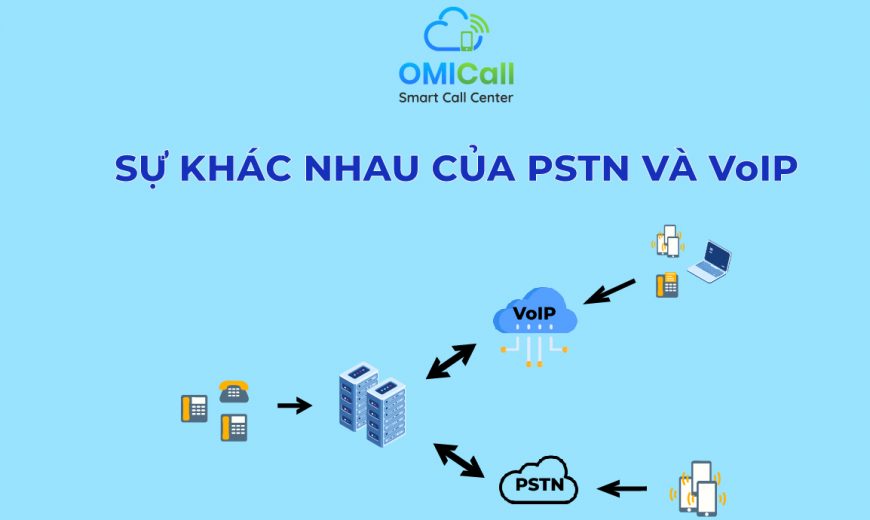
Comparing PSTN and VoIP, along with other PBX technologies.
Reading time: 3 minutes
The first prerequisite for a professional call center is the phone number. This article will compare PSTN and VoIP, along with other popular phone number technologies currently available. Let’s explore the advantages and disadvantages of each solution.
Types of Call Center Number Technologies
PSTN/VoIP technology for fixed lines and 1900/1900 numbers
PSTN technology was invented in the 19th century. Using copper wiring, PSTN provided businesses and households with a reliable communication solution for generations. Associated with this technology were fixed-line numbers such as 028 in Ho Chi Minh City, 024 in Hanoi, etc., or 1900/1800 numbers. Today, fixed-line/1900/1800 numbers have been implemented using VoIP technology. Internet cables have replaced copper wires plugged into Ethernet ports on landline phones. Voice over the Internet is the new trend in modern telecommunications.
Note: 1900/1800 numbers are professional numbers but cannot make outgoing calls. Customers contacting a 1900 number will be charged a fee to the network provider. Conversely, with an 1800 number, the business will pay the call charge to the network provider.
GSM/Mobile SIP Trunk Technology for Mobile Numbers
GSM technology is associated with personal mobile numbers. Simply inserting a SIM card into your phone allows you to make and receive calls. Recently, a new technology has emerged that can be deployed on this type of number: Mobile SIP Trunk. Also based on the Internet Voice platform, Mobile SIP Trunk can virtualize the SIM card. You can still make and receive calls with your mobile number using Softphone/Web applications on your mobile phone or computer.
Comparison Table of Advantages and Disadvantages of PSTN/VoIP/Mobile SIP Trunk Technology
| FIXED NUMBER | MOBILE PHONE NUMBER | 1900/1800 | ||||
| TECHNOLOGY | PSTN | VoIP | GSM | Mobile SIP Trunk | PSTN | VoIP |
| Characteristic | The telephone cable system is a “use wherever you need it” approach. | Connect via Internet connection. | Insert the SIM card into your mobile phone. | Connect via Internet | The telephone cable system is a “use wherever you need it” approach. | Connect via Internet connection. |
| Advantage | Stable connection | Receives multiple calls simultaneously. Flexible, can be used anywhere. Easily expandable. Easily connects with other software. | Stable connection. Many promotional packages available. | Receives multiple calls simultaneously. Flexible, can be used anywhere. Easily expandable. Easily connects with other software. | Stable connection | Receives multiple calls simultaneously. Flexible, can be used anywhere. Easily expandable. Easily connects with other software. |
| Weakness | Difficult to expand Difficult to move Unable to connect with other software | Call quality depends on the quality of your internet connection. | Unable to receive multiple calls simultaneously Unable to connect to customer service support software | Call quality depends on the quality of your internet connection. | Difficult to expand, difficult to move, unable to connect with other software. | Call quality depends on the quality of your internet connection. |
In Conclusion
The above is a comparison and evaluation of the advantages and disadvantages of PSTN and VoIP technologies, along with solutions for mobile phone numbers. Hopefully, this article has answered your questions about mobile phone number technology. If you need any further advice, please contact us for the best support.
VIHAT TECHNOLOGY Co., Ltd
Headquarters: ViHAT Building – 06 Street No. 16 (Him Lam Residential Area) – Hiep Binh Chanh Ward – Thu Duc District – Ho Chi Minh City
Hanoi Branch: Floor 15, LADECO Building, 266 Doi Can, Ba Dinh, Hanoi
Cambodia Branch: Thida Rath #154 St. 33MC, Sangkat Steung Meanchey, Khan Mean Chey, Phnom Penh

-
 What is TikTok advertising? Advertising policies and how it works.
-
 Exploring Conceptual Selling – Understanding Modern Sales Trends Correctly
-
 What is a KOC? Distinguishing between KOLs and KOCs.
-
 What Are Customer Insights? Revealing How to Effectively Uncover Them
-
 What is Digital Marketing? 10 Effective Forms of Digital Marketing
-
 What is Online Marketing? Types of Online Marketing





