
Distinguishing Between Omnichannel and Multichannel
Reading time: 14 minutes
Have you ever bought something online but couldn’t return it at the store? Or seen a brand with different prices on its website and on Shopee? This is the difference between how businesses operate using Omnichannel and Multichannel models. Differentiating between Omnichannel and Multichannel will help you understand why some brands create a smooth shopping experience, while others cause inconvenience for customers.
1. Why do businesses need a multi-channel sales strategy?
Multichannel shopping trends – Customer behavior has changed.
Today’s customers don’t simply go to a store to buy goods or order through a single channel anymore. They may search for products from multiple sources such as e-commerce platforms, friends and family, then check reviews on fan pages, message to inquire about prices, but ultimately order on Shopee because of a discount code…
This diversity in shopping behavior forces businesses to have a multi-channel sales strategy to avoid missing customers at any touchpoint.
Businesses need a clear strategy – having many channels isn’t enough!
Expanding sales channels is a crucial first step, but to create sustainable growth, businesses need a smart strategy for connecting these channels. Simply opening many channels without synchronization will lead to difficulties in data management, operations, and customer service.
At this point, businesses need to clearly understand both the Multichannel and Omnichannel models in order to develop strategies that align with their capabilities and growth goals.
2. Differentiating between Omnichannel and Multichannel
What is the difference between Omnichannel and Multichannel?
2.1 Multichannel – Traditional Multichannel Selling
Multichannel is a sales model in which businesses use multiple different channels to reach customers, but these channels operate independently and are not interconnected.
To put it simply: You have a store on Facebook, Shopee, a website, and a physical store. Each channel has its own pricing policies, promotions, and customer service procedures. Customer data is not synchronized; customers who buy on Shopee only have their information stored on Shopee, and those who buy on the website only have their data stored on the website.
Here’s a real-world example:
- A customer ordered a product on Facebook, but when they went to the store to inquire about the order, the staff couldn’t find it because the two systems weren’t linked.
- Businesses have promotional programs on their websites, but customers find the prices on Shopee cheaper, causing confusion and loss of trust.
- It’s difficult to provide customer service because you can’t track purchase history across different platforms.
Characteristics of Multichannel:
- Reach customers through multiple channels, expanding your sales reach.
- Easy to implement, no need to invest in a complex management system.
- Data is scattered, making it difficult to track customer journeys and personalize the experience.
- Customers have a fragmented experience across channels, which can easily lead to customer loss.
2.2 Omnichannel – Integrated Multi-Channel Sales
Omnichannel is a sales model where all channels are interconnected, creating a seamless experience for customers, no matter where they shop.
To put it simply: Customers can view products on the website, order via Facebook, pick up their orders at the store, and return or exchange items through Shopee without any hassle. All customer data, orders, and purchase history are stored centrally. Customer service is also very easy because staff can access all information regardless of which channel the customer purchased through.
Here’s a real-world example:
- A customer ordered shoes online, but when they arrived at the store, the staff immediately recognized them and easily helped them exchange them for a different size.
- A customer who previously messaged about a product on Facebook then placed an order on Shopee; the system still recorded this and suggested similar products for their next purchase.
- Businesses run synchronized promotions across all channels, so customers no longer feel discriminated against between platforms.
Characteristics of Omnichannel:
- Creating a seamless shopping experience allows customers to easily switch between channels.
- Customer data is synchronized, enabling personalized experiences and better customer care.
- Easily track business performance, optimize advertising, and increase revenue.
- Investment is needed in a management system and software for data synchronization.
- It requires a rigorous operational process to ensure all channels function consistently.
In summary: Multichannel is like opening many separate stores that aren’t connected. Omnichannel, on the other hand, transforms all your stores into a unified system, providing a consistent customer experience. If your business wants long-term growth and customer retention, omnichannel is the inevitable path.
3. What should businesses consider when implementing Omnichannel and Multichannel?
What should businesses consider when implementing Omnichannel and Multichannel?
Both multichannel and omnichannel are multi-channel sales strategies, but they differ in how the channels operate, interact with customers, and connect data. Businesses need to understand these differences to choose the right model, optimize business performance, and enhance customer experience.
3.1 Business mindset and strategic goals
Multichannel – Focus on expanding sales channels
Multichannel aims to expand customer reach by having a presence across multiple platforms. Businesses utilize individual channels such as websites, social media, e-commerce platforms, and physical stores to increase sales opportunities.
However, each channel can operate independently, without connection or data synchronization, leading to an inconsistent customer experience.
For example, a cosmetics brand has a presence on Shopee, Facebook, and its website, but its pricing and promotional policies are inconsistent. Customers who buy on Shopee receive discounts, but not those who buy through the website, creating a sense of unprofessionalism and eroding brand trust.
Omnichannel – Focusing on optimizing the customer experience.
Omnichannel goes beyond simply expanding channels; it connects and synchronizes all channels, providing customers with a seamless shopping experience. All customer information, orders, and transaction history are linked, enabling businesses to personalize services and build long-term relationships with customers.
For example: A customer orders perfume on the website but chooses to pick it up at the store. Upon arrival, the staff already have the order information in the system, allowing the customer to receive their order quickly without needing to present a receipt. If they need to exchange a product, they can do so immediately at the store or via Zalo OA, without any obstacles.
3.2 How to manage channels and customer data
Multichannel – Customer data is scattered.
In the multichannel model, customer data is separated across channels. If a customer purchases through Shopee, their information is stored only on Shopee; if they purchase on the website, the business has to enter their data separately.
As a result, businesses are unable to track the entire customer shopping journey. Personalizing the customer experience becomes difficult because each channel only has a portion of the information. Customer service is limited because data is not shared between channels.
For example, a customer who previously purchased shoes on the website might contact the staff via Facebook to inquire about the warranty policy, but the staff cannot retrieve their order information. This causes the customer to waste time repeatedly asking for information and can lead to a negative experience.
Omnichannel – Synchronized customer data
Omnichannel helps businesses store customer data centrally, allowing them to track the entire shopping journey and interactions across all channels.
When customers contact us via Facebook, Zalo, website, or visit the store in person, staff can access their purchase history. Special offers, promotions, and after-sales services are also personalized based on customer data, helping to increase repeat purchases.
For example: A customer previously purchased a computer at the store. When they return to buy accessories on the website, the system automatically suggests products compatible with the computer model they previously purchased. If the customer needs assistance, the call center agent can also quickly access their purchase history without having to ask for too much information again.
3.3 Customer Experience – The Core Differentiator
Multichannel – A fragmented experience across channels
In a multichannel model, customers may encounter difficulties switching between channels.
For example, a customer orders clothes on Facebook, but when they arrive at the store to pick up the order, the staff cannot track the order because the system is not linked. This causes inconvenience for the customer and may lead them to cancel the order.
Omnichannel – A seamless, consistent experience.
Omnichannel helps customers easily switch between channels, providing a seamless and convenient experience.
For example: A customer places an order through the app, then visits the store to try on clothes before deciding to buy. Because the system already has the order information, staff can provide quick assistance, giving the customer a better experience.
3.4 Technology and Management Systems
Multichannel – Simple to manage, but prone to problems when expanding.
Multichannel doesn’t require investment in complex management systems. However, as businesses expand, data becomes difficult to manage, leading to errors in order management and customer service.
Omnichannel – Investment in a professional management system is necessary.
Omnichannel requires the use of CRM, ERP, and POS systems to synchronize customer and order data across all channels. OMICall’s omnichannel system can also support businesses in applying AI, chatbots, and marketing automation to optimize customer experience effectively.
4. So which model should businesses choose?
Both omnichannel and multichannel are important sales strategies, but each model is suitable for different types of businesses. Choosing the right strategy not only helps businesses optimize revenue but also improves customer experience and optimizes operations.
Distinguishing Between Omnichannel and Multichannel
When should businesses choose multichannel?
Multichannel is a suitable option if a business is in the market expansion phase, reaching many new customers, but does not yet have sufficient resources to invest heavily in technology and centralized management systems.
Multichannel is suitable for businesses and brands such as:
- Small and medium-sized enterprises (SMEs) do not yet have complex management systems.
- Startup companies or newly opened stores want to increase revenue quickly by expanding into multiple sales channels.
- The brand lacks a loyal customer base and needs to be present on multiple platforms to attract new customers.
- Businesses that sell through campaigns focus on short-term marketing rather than building a long-term customer base.
Practical example: A newly opened fashion shop chooses to sell on Shopee, TikTok Shop, Facebook, and its website, each channel having its own discount program. Because the business is only focused on immediate revenue, they don’t yet need to worry about synchronizing customer data or optimizing the user experience across channels.
Advantages and disadvantages of multichannel
Multichannel marketing can quickly expand the customer base by leveraging multiple platforms. Deployment costs are low, and there’s no need for immediate investment in large data management systems. Sales strategies are easily adjusted and adapted to each platform.
However, there’s a lack of connectivity between channels, potentially confusing customers when they want to switch platforms (for example, buying on Facebook but not being able to exchange items in-store). Customer data isn’t optimized, making it difficult to implement personalized marketing campaigns. Operational management becomes challenging as the system scales, especially with too many separate channels operating simultaneously.
Multichannel is a good solution if a business wants to grow quickly in the initial stages, but it will face difficulties in retaining customers and managing the system in the long term.
When should businesses choose omnichannel?
Omnichannel is a long-term solution for businesses looking to build a seamless sales ecosystem, providing customers with a consistent experience regardless of the platform they use.
Omnichannel is suitable for:
- Businesses with a stable customer base want to enhance the shopping experience and increase repeat business rates.
- Large brands or retail chains need to manage data synchronously across multiple channels to optimize operations.
- The company has a budget to invest in CRM, ERP, and POS systems to help connect sales channels seamlessly.
- Businesses want to personalize customer service, using data to improve marketing and customer care effectiveness.
Practical example: A chain of phone stores adopts omnichannel, allowing customers to order online on the website, pay via ZaloPay, and then pick up their order at the nearest store. If customers need to return or exchange an item, they can do so on any platform without difficulty.
The advantages and disadvantages of omnichannel.
Omnichannel creates a seamless shopping experience, making it easy for customers to access products regardless of which channel they are using. Customer data is synchronized, helping businesses understand buyer behavior and personalize the experience better. Marketing and advertising performance is increased by accurately tracking the customer journey and optimizing conversions. Customer service performance is improved, providing faster support across all platforms.
However, omnichannel requires investment in technology and management systems, such as CRM, ERP, and POS. A data synchronization strategy is necessary; otherwise, managing multiple channels will become complicated. It demands a professional operations team and experienced personnel to manage the system.
5. Applications of Omnichannel and Multichannel in various industries
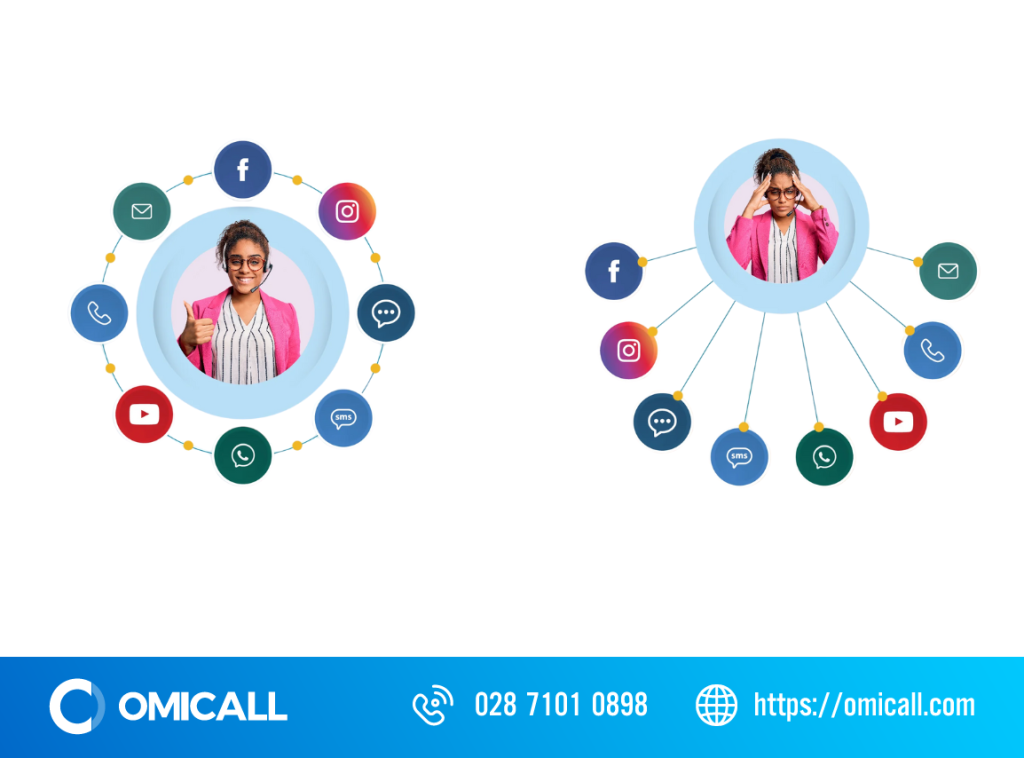
Applications of Omnichannel and Multichannel in various industries
5.1 Retail Sector – Fashion, Cosmetics, Electronics
Multichannel
Practical applications:
- The company sells its products through various channels such as websites, Facebook, Shopee, Lazada, and physical stores.
- Run separate advertising and promotional campaigns on each channel to attract customers.
- Customer data is not synchronized, and each channel has different pricing and after-sales policies.
The results achieved:
- Rapid market expansion helps brands reach more customers.
- Increase sales from multiple sources, leveraging the strengths of each sales platform.
- Customers have a fragmented and confusing experience regarding pricing and policies.
- Businesses find it difficult to control customer data, making it impossible to personalize offers effectively.
Omnichannel
Practical applications:
- Connect all sales channels into a centralized management system (CRM, POS).
- Customers can order online, pick up their orders at the store, or return or exchange items at any branch.
- Integrate customer data and personalize promotions based on purchase history.
The results achieved:
- Customer return rates have increased significantly, thanks to a seamless experience and personalized offers.
- This reduces order cancellations because customers have more flexible delivery options.
- Marketing costs are optimized because customer data is effectively utilized for remarketing.
5.2 Food and Beverage (F&B) Industry
Multichannel
Practical applications:
- The business sells its products through various food delivery apps such as ShopeeFood, GrabFood, Baemin, its own website, and physical stores.
- Each channel has different promotions and prices, so customers should only choose the channel with the best offer.
- Without a customer data management system, it’s impossible to accumulate membership points when ordering online.
The results achieved:
- Sales increased thanks to the flexibility across platforms.
- Reaching new customers is easier, leveraging the advantages of each ordering app.
- Without control over customer purchasing behavior, it’s easy to lose customers to competitors.
- Loyalty cannot be built because there is no data to personalize the experience.
Omnichannel
Practical applications:
- Connect your ordering app, website, and physical stores into a single system.
- Customers can order food through the app, earn points, and redeem them for discounts when purchasing directly at the store.
- Use data to personalize promotions and suggest dishes based on purchase history.
The results achieved:
- Retain customers long-term through a consistent experience and a comprehensive membership program.
- Reduce reliance on third-party applications and increase profitability from direct orders.
- Optimize marketing costs by leveraging customer data for effective remarketing.
5.3 Finance – Banking – Insurance Sector
Multichannel
Practical applications:
- The bank provides services through its website, mobile app, hotline, and branches, but each channel operates independently.
- Customers have to re-provide information when switching between channels, which is time-consuming.
- Lack of synchronized data on customer behavior makes consulting services ineffective.
The results achieved:
- Reaching customers through multiple channels helps increase the number of transactions.
- Poor customer experience due to inconsistent processes.
- It’s difficult to optimize personalized services because there’s no system for analyzing user behavior.
Omnichannel
Practical applications:
- Connect all trading channels into a centralized management system.
- Customers can register for services on the app, receive advice via chatbot, and continue transactions at the branch without wasting time re-entering information.
- Customer data is analyzed to personalize financial products tailored to each individual.
The results achieved:
- Significantly improves customer experience and reduces transaction processing time.
- Increase conversion rates and customer loyalty through seamless and personalized service.
- Improve employee productivity through digitized and synchronized data.
Distinguishing between Omnichannel and Multichannel will help businesses choose the strategy that best suits their business goals. If a business wants to expand rapidly and reach more customers, Multichannel is the right choice. However, if the goal is to enhance the shopping experience, retain customers long-term, and optimize operations, Omnichannel is the inevitable trend.
For further information, please contact:
VIHAT TECHNOLOGY Co., Ltd
Headquarters: ViHAT Building – 06 Street No. 16 (Him Lam Residential Area) – Hiep Binh Chanh Ward – Thu Duc District – Ho Chi Minh City
Hanoi Branch: Floor 15, LADECO Building, 266 Doi Can, Ba Dinh, Hanoi
Cambodia Branch: Thida Rath #154 St. 33MC, Sangkat Steung Meanchey, Khan Mean Chey, Phnom Penh

-
 What is TikTok advertising? Advertising policies and how it works.
-
 Exploring Conceptual Selling – Understanding Modern Sales Trends Correctly
-
 What is a KOC? Distinguishing between KOLs and KOCs.
-
 What Are Customer Insights? Revealing How to Effectively Uncover Them
-
 What is Digital Marketing? 10 Effective Forms of Digital Marketing
-
 What is Online Marketing? Types of Online Marketing





