
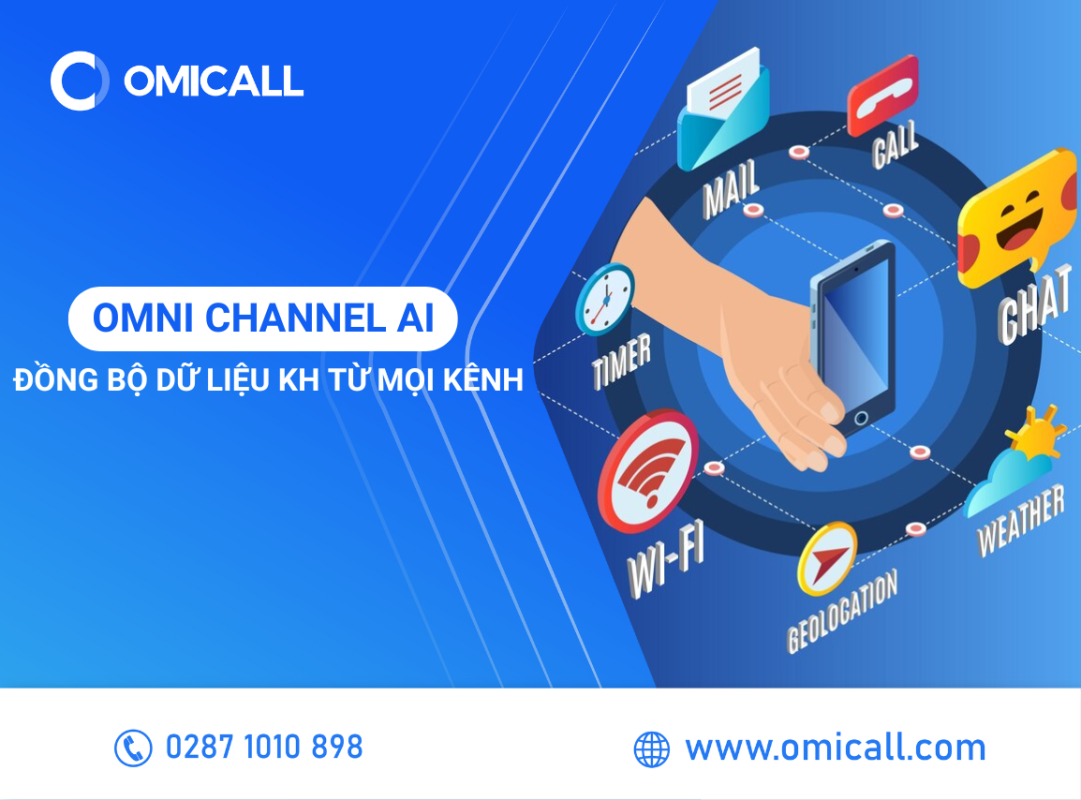
Omni-Channel AI – Synchronizing Customer Data Across All Channels
Reading time: 14 minutes
As customers increasingly adopt omnichannel shopping behaviors, how can businesses not only keep pace but also take the lead? Omni-channel AI is the breakthrough solution that enables businesses to leverage customer data from every channel, predict trends, and enhance operational efficiency.
- What is Omni-channel AI?
Omni-channel (an integrated multi-channel strategy) is a business approach focused on connecting and integrating all of a company’s sales, marketing, and service channels—both online and offline—to create a seamless customer experience.
Today’s customers do not interact with a business through just a single channel. They might research products on a website, place orders via a mobile app, receive promotional information via email, or have a hands-on experience in a physical store. An omni-channel strategy helps businesses unify these channels to ensure information consistency across the board, allowing customers to switch between channels easily without disrupting their experience.
Real-world example: A customer searches for a product on an e-commerce site and then visits a physical store to see it in person. The omni-channel system recognizes the customer, records their online behavior, and suggests suitable products right there in the store.
1.1 AI in Omni-channel
Artificial Intelligence (AI) is the core technology that optimizes omni-channel strategies by providing analytical, predictive, and automation capabilities. AI enables businesses not only to connect channels but also to significantly improve operational efficiency and the customer experience.

AI in Omnichannel
Analyzing customer data from multiple channels
AI can collect and analyze vast amounts of customer data from various sources: websites, mobile apps, social media, email marketing, retail POS systems, and customer service channels.
Example: AI analyzes purchase history to identify a customer’s product preferences, then suggests similar products across other channels.
Predicting customer shopping behavior and preferences
Using machine learning algorithms, AI can predict when a customer is likely to make a repeat purchase and which products best suit each individual.
Example: If AI predicts that a customer typically buys winter clothing at the start of the season, it can automatically send an email featuring relevant promotional products just before that time.
Automating and personalizing customer interactions
AI helps businesses automate tasks such as sending automated marketing emails and deploying 24/7 customer support chatbots across multiple platforms (Facebook Messenger, Zalo, websites).
AI also ensures that outgoing content is personalized for each customer based on their behavior, preferences, and interaction history.
Example: A customer searches for running shoes on a website and subsequently receives a mobile app notification about a discount on the specific type of shoes they were interested in.
- The role of Omnichannel AI for businesses
2.1 Optimizing Customer Experience (CX)
Omnichannel AI helps businesses eliminate “friction points” in the customer’s shopping journey. The AI system synchronizes data across online channels (websites, apps, social media) and offline channels (physical stores, call centers, showrooms) to create a unified, seamless experience. Customers feel understood and valued, which boosts cross-channel conversion rates and reduces cart abandonment. Brand loyalty increases thanks to a consistent and convenient shopping experience.
Practical Application
When a customer visits a website to view products, AI records their behavior (products viewed, time spent on the page, purchase history). When the customer visits a physical store, sales staff can access this data via an AI-integrated customer management system, enabling them to provide accurate recommendations based on the customer’s interests.
Example: A fashion brand uses AI for data synchronization. If a customer adds shoes to their online cart but does not complete the purchase, they receive a suggestion message from an AI-powered chatbot via Zalo or the brand’s app. If the customer later visits the store, sales staff are notified that the customer viewed the product online, allowing for better consultation and increasing the likelihood of a sale.
2.2 Interaction Personalization
AI utilizes customer behavioral data (such as purchase history, preferences, and browsing habits) to personalize every interaction, tailoring content, messages, and offers to the individual rather than employing a mass-market approach. This drives higher email open rates, ad click-through rates, and purchase conversions through relevant content. It fosters lasting customer relationships and optimizes marketing costs by reaching the right people with the right message at the right time. Practical Applications
Sending personalized advertising messages: AI analyzes data to identify products of interest to the customer, then sends advertisements or messages at the right moment.
Example: A customer purchases a smartphone from a website and subsequently receives an email recommending compatible accessories, such as a protective case or wireless earbuds.
Personalizing offers and promotions: Based on purchase history, AI automatically segments customers and sends tailored promotions.
Example: A frequent VIP customer receives a 20% discount code via email or SMS on their birthday, along with recommendations for the latest products.
2.3 Predicting customer behavior (Predictive Analytics)
AI utilizes big data from CRM systems, social media, websites, and other touchpoints to predict which products a customer is likely to buy in the future, when they might return to make a purchase, and what factors influence their buying decisions. This enables the optimization of resources, reduction of inventory levels, and assurance of product availability when needed. It boosts sales by reaching customers at the moment they are most likely to convert and improves the accuracy of marketing and sales planning.
Practical Applications
Predicting best-selling products: AI analyzes shopping trends and seasonal data to forecast which products will sell well during different seasons. Example: AI suggests stocking up on lightweight jackets in late September, based on the previous year’s sales data and weather trends.
Predicting customer return times: Based on repeat behavior, AI determines when a customer is likely to return. Example: A customer who typically purchases coffee from the store on a weekly basis. If they skip a week, the AI sends an email or app notification with an offer to encourage them to return.
2.4 Enhancing the effectiveness of multi-channel marketing strategies
AI integrates data from multiple channels (Google Ads, Facebook Ads, email marketing, social media) to provide detailed insights into the performance of each channel, thereby optimizing marketing strategies. Optimize marketing costs and reduce budget waste on underperforming channels. Improve conversion rates by optimizing content and campaigns for each channel. Formulate marketing strategies quickly based on real-time data.
Practical Applications
Efficient advertising budget allocation: AI analyzes the effectiveness of each channel (cost-efficiency) and automatically allocates the budget to the channels generating the highest revenue. For example, if Google Ads generates more revenue than Facebook Ads, the AI will automatically increase the budget for Google Ads.
Monitoring and optimizing marketing performance: AI continuously tracks data from marketing campaigns to adjust content, timing, and distribution channels. For example, if the AI detects low email open rates in the evening but higher rates in the morning, the system automatically adjusts the sending time to improve performance.
Customer Journey Analytics: AI helps businesses track customers from the moment they become aware of the brand until they complete a purchase, thereby identifying weak points in the customer journey.
Vietnam’s leading AI-powered multi-channel virtual contact center
- Applications of Omni-Channel AI across industries
Omni-channel is not merely a theoretical strategy; it is widely applied across various business sectors. Below is how key industries utilize the omni-channel approach to enhance operational efficiency and customer experience.
Retail
Customers can view products online, check stock availability at the nearest store, reserve items online, and pick them up in-store (click-and-collect). AI systems enable store staff to see what customers have viewed online, allowing them to provide tailored product recommendations.
Example: A customer searches for a phone or accessory on a website and receives a notification that the nearest store has the item in stock. They can then visit the store to experience the product and make a purchase. Personalized promotions are sent via SMS or email based on their shopping history.
E-commerce
AI tracks customer behavior on websites or mobile apps to suggest relevant products. The omni-channel approach integrates channels such as Zalo, Facebook Messenger, and email to provide post-purchase support or encourage the completion of abandoned orders.
Example: Lazada uses AI-integrated chatbots to assist customers immediately when they have questions. Additionally, notifications regarding promotions and discounts are sent via email and mobile apps, ensuring a consistent approach to customer engagement.
Benefits: Increases conversion rates by reducing cart abandonment. Improves the shopping experience through accurate product recommendations.
Fast-Moving Consumer Goods (FMCG)
AI predicts shopping trends to suggest suitable products and effectively manage inventory. Integration of online (shopping apps, websites) and offline (convenience stores) channels to provide consistent offers.
Example: At VinMart, customers can make purchases via the VinID app—earning loyalty points in the process—and choose to either pick up their items in-store or have them delivered to their doorstep. Member-exclusive offers apply consistently across both online and offline channels.
Benefits: Increases customer loyalty through integrated point-accumulation programs and offers. Improves operational efficiency by utilizing real-time inventory and purchasing data.
Banking
Customers can initiate transactions via a mobile banking app, continue them at an ATM, and finalize them at a bank branch without having to re-enter information from scratch. AI analyzes data to provide tailored financial recommendations, such as suitable loans or savings products, for each customer.
Example: TPBank has deployed LiveBank (an automated banking service) where customers can perform transactions like opening accounts or setting up online savings. Simultaneously, notifications regarding new financial products are sent via SMS, email, and the mobile app.
Food & Beverage (F&B)
Customers can make reservations or pre-order meals via a website, app, or phone call. The omnichannel system records customer requests and order history to suggest favorite dishes when they return.
Example: The Coffee House allows customers to order drinks via the app, receive offers via email, and earn membership points. If customers visit the store in person, they can still access the same promotional programs available for online orders.
Benefits: Boosts sales through pre-ordering and personalized promotions. Enhances customer service by maintaining a record of transaction history. Travel and Tourism
Customers can search for flight information and book flights or hotels via various channels (websites, apps, travel agencies). Data is synchronized to prevent errors during the booking process. AI analyzes customer data to recommend travel packages and ancillary services, such as car rentals or local experiences.
Example: Customers can book flights via an app, receive flight details via email, and manage their itinerary (e.g., changing flight times or selecting seats) on a single platform. Loyalty programs, such as LotusMiles, are also personalized based on flight history.
Benefits: Enhanced customer experience through easily managed itineraries. Increased revenue driven by recommended ancillary services.
Education
Training centers and schools use omnichannel strategies to synchronize in-person classes with online learning platforms. AI can track student progress and recommend suitable courses.
Example: Centers use AI-integrated online learning platforms to monitor student schedules. Simultaneously, notifications and study materials are sent via email, apps, and SMS to ensure students do not miss any content.
Benefits: Improved learning efficiency through personalized programs. Higher course completion rates and increased student satisfaction.
- How to Implement Omnichannel AI for Businesses
To successfully implement omnichannel AI, businesses must follow a systematic, step-by-step approach, ensuring alignment across technology, processes, and people. Step 1: Assess the business’s current state
Before implementing Omni-Channel AI, the business needs a clear understanding of its current situation to formulate an appropriate strategy. This provides an overview of the status of sales channels and data, helping to clearly identify strengths, weaknesses, and issues that need addressing.
Tasks to be performed:
Identify sales and marketing channels currently in use: List existing channels—such as websites, mobile apps, Facebook, Zalo, customer service hotlines, and physical stores—and evaluate the effectiveness of each channel in attracting, engaging, and retaining customers.
Check data synchronization capabilities across channels: Are customer data from different channels connected and synchronized? Are there instances of fragmented or inconsistent data across channels?
Internal capability assessment: What technology systems does the business already have in place (e.g., CRM, POS, ERP, advertising tools)? Is the internal team ready to adopt new technology?
Step 2: Choosing OMICall’s Omni-Channel AI solution
OMICall is a pioneering provider of Omni-Channel AI platforms, enabling businesses to connect and manage all sales and customer care channels within a single system.
Why choose OMICall?
Multi-channel integration: Manage channels such as websites, Facebook, Zalo, call centers, email, and SMS simultaneously via a single interface. Data from all channels is synchronized, making it easy for businesses to track the customer journey.
Marketing and customer care automation:
- AI Chatbot: Provides automated 24/7 customer support across channels such as Facebook Messenger, Zalo OA, and websites.
- Automated Customer Segmentation: Automatically categorizes customers based on behavior, purchase history, or personal information, and suggests appropriate marketing strategies.
- Automated Messaging: Sends notifications and promotional offers via SMS, email, or Zalo based on customer behavior.
AI-Integrated CRM: OMICall offers a smart CRM solution that comprehensively stores customer information—ranging from transaction history and multi-channel interactions to support requests. AI analyzes and predicts customer behavior, enabling businesses to implement effective personalization strategies.
Smart Call Center Integration (Cloud Call Center): Integrates an AI-powered call center to facilitate automated customer care and call handling. Calls are recorded, stored, and analyzed to drive service improvements.
Businesses can save time and reduce management costs by integrating all communication channels, while simultaneously enhancing the customer experience through synchronized, personalized service.

How to Implement Omni-Channel AI
Step 3: Integration and Training
After selecting the appropriate Omni-Channel AI solution, the next step is to integrate the technology into operational workflows and train staff to ensure effective usage.
Implementation:
Integrate technology with existing systems: Connect OMICall with current platforms (CRM, POS, ERP, advertising tools). Ensure data from channels such as websites, social media, call centers, and email is synchronized.
Personalize configuration: Customize AI chatbots, automated emails, or customer care scripts to suit specific business needs. Set up automation rules, such as sending messages when customers abandon their shopping carts or reminding them of products they have viewed.
Train staff: Organize training sessions so employees understand how to use the OMICall system—from leveraging customer data and managing AI chatbots to personalizing the customer experience. Focus on training customer service and sales teams to help them maximize the use of Omni-Channel AI tools.
Desired outcomes: A fully integrated and stably operating system; staff who have mastered the technology and new workflows.
Step 4: Monitoring and Optimization
Implementing Omni-Channel AI is not a one-time task but an ongoing process of optimization to achieve maximum effectiveness.
Implementation:
Set clear KPIs: Determine the success rate of each channel in converting leads into buyers. Measure customer satisfaction levels across each channel. Evaluate the ROI (Return on Investment) for each advertising campaign. Monitor performance via real-time data: Use analytics reports from OMICall to track channel performance. Analyze the customer journey to identify experience gaps and areas for improvement.
Continuous optimization: Fine-tune chatbot content, email marketing, and advertising campaigns based on collected data. Develop new customer care scenarios to boost conversion rates and loyalty.
Implementing Omni-Channel AI offers a breakthrough opportunity for customer management and multi-channel marketing. It is the key for businesses to modernize processes, meet customer needs, and comprehensively increase business value.
For more information, please contact:
VIHAT TECHNOLOGY Co., Ltd
Headquarters: ViHAT Building – 06 Street No. 16 (Him Lam Residential Area) – Hiep Binh Chanh Ward – Thu Duc District – Ho Chi Minh City
Hanoi Branch: Floor 15, LADECO Building, 266 Doi Can, Ba Dinh, Hanoi
Cambodia Branch: Thida Rath #154 St. 33MC, Sangkat Steung Meanchey, Khan Mean Chey, Phnom Penh

-
 What is TikTok advertising? Advertising policies and how it works.
-
 Exploring Conceptual Selling – Understanding Modern Sales Trends Correctly
-
 What is a KOC? Distinguishing between KOLs and KOCs.
-
 What Are Customer Insights? Revealing How to Effectively Uncover Them
-
 What is Digital Marketing? 10 Effective Forms of Digital Marketing
-
 What is Online Marketing? Types of Online Marketing





