

What is a workflow? How to build a proper marketing workflow.
Reading time: 11 minutes
What is a workflow ? How does it benefit businesses? Let’s explore in detail how to build an effective workflow for your business in the article below!
What is a workflow?
A workflow is understood as a process or work procedure used to describe tasks that need to be completed according to a specific procedure. When a task is assigned to a process, it will automatically run through each stage of the workflow.
Therefore, workflows are very useful in ensuring that critical processes are performed correctly every time. They help your work get done quickly, minimizing errors and bottlenecks. At the same time, managers can accurately track how work is being done or use it to design a scientific and highly efficient work sequence.

Vietnam’s leading AI-powered multi-channel virtual call center.
Example of a workflow process
The company has established a new employee onboarding process with the following steps:
Preparation before employee arrival => Reception and introduction => Guidance and training => Training and assignment of tasks => Start of work.
The HR department will then understand the process and follow the steps above to onboard new employees when they join the company.

What is a workflow?
6 benefits you should know about workflow.
Workflow is a crucial tool that helps businesses streamline their processes and increase labor efficiency. Therefore, every business should utilize workflow in its operations due to the following benefits:
Business performance improved.
Workflows help your business eliminate unnecessary steps and automate tasks according to a logical workflow. By establishing clear processes, workflows increase productivity and save employees the time and effort needed to complete tasks.
With an optimally designed workflow, businesses can improve their operations by ensuring that tasks are completed by the right employees, in the correct order, and within a defined timeframe.
Reduce risks and operating costs.
A workflow diagram can automate tasks, eliminating manual steps that risk errors and confusion in the workflow process. Based on workflows, businesses can identify potential risks, mitigate them, and implement appropriate preventative measures. When work progresses faster, businesses will need fewer resources to achieve their goals, reducing costs and maximizing profits.
Fast operating process
Another great benefit of workflow is its smooth and efficient operation. When businesses implement workflow , employees can easily identify specific tasks and jobs, and carry out those tasks in an orderly and standardized manner.
Furthermore, workflows can automate simple tasks, enabling you to analyze business, build expansion plans, and prepare for risk mitigation.
Eliminate unnecessary manual tasks.
When a company has too many complex activities and a large workload, designing a streamlined workflow is crucial to identify redundant and overlapping tasks and roles.
When workflows are implemented in daily operations, you can eliminate many redundant and repetitive tasks. This makes it easier to streamline and organize work scientifically, saving time for other tasks. In addition, it helps you improve work processes and eliminate unnecessary activities.
Process automation
A workflow is not simply a list of work steps; it helps businesses optimize their current processes. By evaluating and analyzing unnecessary or repetitive tasks, a workflow reduces the risk of errors, improves efficiency, and frees up team members to focus on more important tasks.
For example:
The customer service process can trigger certain actions, such as emails, special offers, etc., to encourage customers to repurchase products/services.
This type of automation can free up staff to focus on appropriate goals. Specifically, sales staff can concentrate on finding new customers, while customer service staff can address any issues customers may encounter.
Enhance connectivity
Workflows create a system with a scientific and clear workflow structure. This increases connectivity among members of an organization. In addition, information and documents are easily shared among members in the process. This helps to speed up work and improve team collaboration, while also completing tasks faster and reducing business costs.
As can be seen, workflows offer many benefits to business operations. A lean workflow will help businesses save a significant amount of resources such as time, effort, and labor, while still creating a process that delivers the desired results.
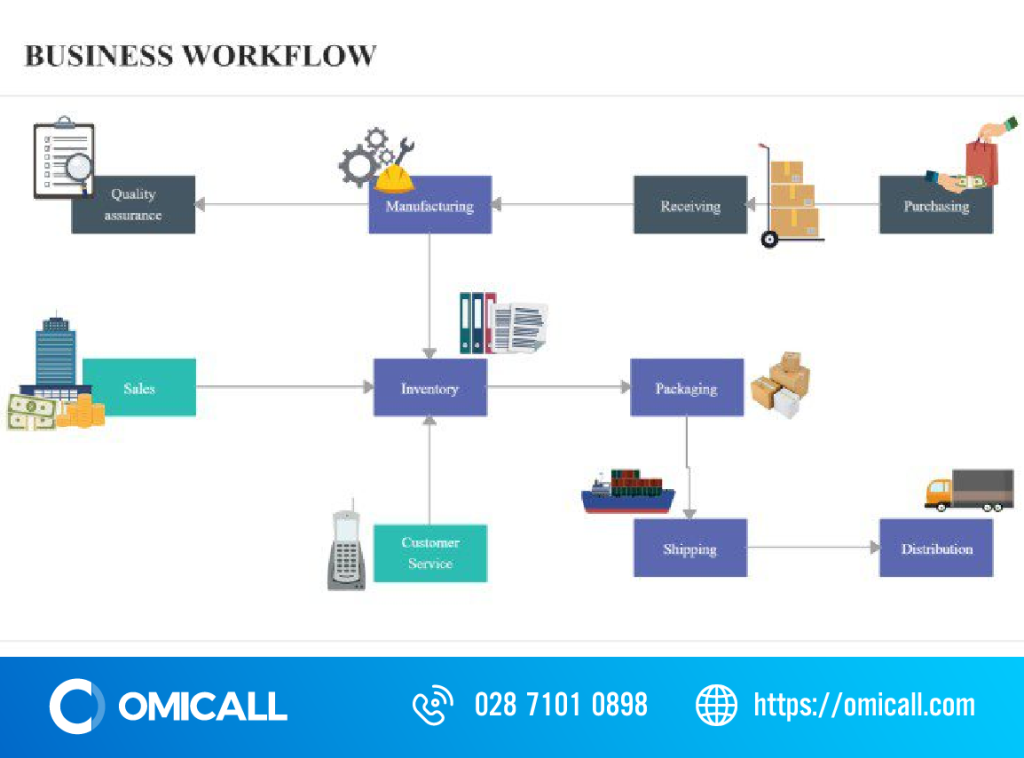
Workflow creates a system with a scientific and clear workflow structure.
Which groups of people need to implement workflows?
Which businesses should use workflows?
- Businesses with complex processes: Involving multiple personnel and departments.
- Businesses with many departments/personnel: This leads to a lack of control in managing and monitoring the work of each department.
- The company has not optimized its resources: It has not fully exploited the potential of each individual, and financial resources have not been optimized.
- Businesses want to improve work efficiency: Work processes are not clearly defined, leading to ambiguity and wasted time and resources.
- Businesses need consistency and coherence: Internal departments operating independently and lacking interaction lead to information loss and reduced work efficiency.
Which departments within the company most frequently use workflows?
- Sales Department: Production management, quality management, purchasing, engineering and maintenance, etc.
- Sales Department: Marketing, sales, customer service, etc.
- Marketing Department : Market research, digital marketing, PR, content, media, etc.
- Operations Department : Supply chain management, maintenance and repair, supply chain management, etc.
- Training Department: Responsible for training implementation, development, content design, etc.
7 steps to building a perfect workflow
To build a truly effective workflow, you need to follow these 7 steps:
Step 1: Identify the necessary data sources.
To create a complete workflow, you first need the relevant databases. This is a crucial foundation for implementing and establishing the most accurate process, ensuring the accuracy and completeness of information in the workflow. This, in turn, enhances efficiency and guarantees work quality.
Before creating a workflow for a specific task, you can rely on the following two data sources:
- Internal data sources: Personnel information, inventory information, project information, business information of the enterprise, etc.
- External data sources: Market news, social events, etc.
Step 2: List the tasks that need to be done in detail.
Detailed task lists within a workflow help create consistency in the work process and prevent errors. Those involved in the process can also clearly understand and grasp the tasks being performed directly within the workflow.
To list the tasks that need to be performed in an effective workflow, follow these steps:
- Define the objectives of the process;
- Analyze and identify the key steps;
- Identify the tasks that need to be done;
- Determine the order in which tasks should be performed;
- Assign tasks to appropriate personnel;
- Evaluate and make changes as needed.
Note: These tasks must be described fully, specifically, clearly, and in the correct order.
For example:
When a business carries out the recruitment process, it needs to list and arrange the steps in the correct order as follows:
- Determine recruitment needs: How many people need to be hired? What positions? What skills, experience, and knowledge are required of the candidates?
- Recruitment planning: When will the recruitment take place? What are the goals, costs, and recruitment needs? What should the recruitment content look like?
- Job analysis : Detailed identification of the experience, skills, and knowledge requirements of candidates.
- Candidate search: What channels does the company use to find candidates? (social media, website, Facebook, etc.) Do they use outsourced recruitment services?
- Candidate screening: Develop criteria for evaluating candidates, compare and select the highest quality CVs.
- Interviewing candidates: Schedule interviews with candidates, choosing between online or offline interview formats.
- Candidate evaluation: Based on criteria such as attitude, knowledge, achievements, etc.
- Job Offer Invitation: When is the job offer invitation period? The job offer letter includes detailed information about work regulations, job requirements, salary, benefits, penalties, etc.
- Welcoming candidates: HR will introduce the company culture and work environment, prepare relevant documents to send to candidates, and direct candidates to their main work department, etc.
Step 3: Identify the person in charge.
Next, you need to clearly define who is responsible for each specific task. This ensures that work is assigned to the right person, for the right job, and at the right time. Simultaneously, employees will understand their responsibilities, ensuring efficiency within the process they follow.
Following up on the tasks in step 2, you will continue to assign roles and responsibilities for each step as follows:
- Assess the capabilities and responsibilities of each member;
- Discuss and consult with those who will be taking over the job;
- Assign tasks to each team member based on their abilities;
- Clearly define the role of each member;
- Establish communication and coordination mechanisms to ensure effective collaboration;
- Monitor and evaluate the work performance of each team member;
- Ensure cooperative relationships among members.
For example:
The company is hiring customer service representatives who will be responsible for the following specific tasks:
- CEO: Approve the recruitment request.
- Department Head: Develop recruitment proposals and recruitment needs, and support HR in screening, evaluating, and interviewing candidates.
- HR: Planning and implementing recruitment plans (searching, screening, interviewing, evaluating candidates, and offering them jobs).

7 steps to building a perfect workflow
Step 4: Design the workflow diagram.
Designing workflow process profiles is an essential part of creating a workflow diagram. However, if you’re not proficient in workflow modeling, choose a user-friendly tool that’s flexible enough to draw a process, no matter how complex it is.
Step 5: Review the created workflow.
Reviewing and evaluating the created workflow is a way to identify potential errors during implementation. Then, you can find solutions and develop contingency plans to improve work efficiency.
How to check the created process:
- Establish criteria for evaluation and comparison, including timelines, feasibility, reliability, and available resources.
- Gather feedback/reviews from stakeholders;
- Suggest improvements when errors are discovered;
- Evaluate the process after adjustments.
For example:
In the customer service recruitment process, businesses can review the created workflow as follows:
Establish evaluation criteria: candidate, company resources, recruitment costs, implementation and completion time, etc.
HR will exchange information and plans with department heads to ensure consistency and uniformity of information, and will make corrections if errors or inappropriate processes are found.
Step 6: Instruct team members on the new workflow.
Training team members on new workflows is a way to ensure consistency and efficiency in the workplace. Businesses can undertake the following activities to train their staff:
- Provide guidance/training for personnel;
- Organize meetings/discussions;
- Implement any workflow template 1;
- Set up a system to notify you about workflows;
- Monitoring and supporting personnel;
- Discuss with the members.
Step 7: Implement the new workflow.
The final step in building a well-structured workflow is implementing the new process. Implementation activities will contribute to improving efficiency, consistency, and quality of work within an organization. Below is a detailed outline of the process for implementing a new workflow.
- Prepare to schedule the deployment;
- Implement the new process;
- Measure, evaluate, and refine;
- Support and ensure compliance with procedures.
In conclusion
Hopefully, this article has provided you with more information about what a workflow is and how to build a proper workflow for your business. Continue following OMICall to discover more interesting and useful articles!
VIHAT TECHNOLOGY Co., Ltd
Headquarters: ViHAT Building – 06 Street No. 16 (Him Lam Residential Area) – Hiep Binh Chanh Ward – Thu Duc District – Ho Chi Minh City
Hanoi Branch: Floor 15, LADECO Building, 266 Doi Can, Ba Dinh, Hanoi
Cambodia Branch: Thida Rath #154 St. 33MC, Sangkat Steung Meanchey, Khan Mean Chey, Phnom Penh

-
 What is TikTok advertising? Advertising policies and how it works.
-
 Exploring Conceptual Selling – Understanding Modern Sales Trends Correctly
-
 What is a KOC? Distinguishing between KOLs and KOCs.
-
 What Are Customer Insights? Revealing How to Effectively Uncover Them
-
 What is Digital Marketing? 10 Effective Forms of Digital Marketing
-
 What is Online Marketing? Types of Online Marketing





